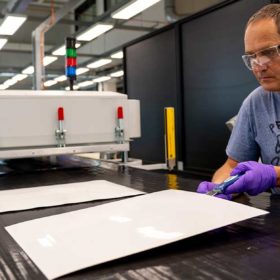
Recyclable, back-contact solar panel from the Netherlands
Conceived by a Dutch consortium, according to Design for Recycling guidelines, the panel is being developed with two different encapsulants, one for the front of the module, which joins the glass and cells together; and a slightly different formulation for the back of the module, which attaches cells and backsheet together.

Plan for solar module gigafactory unveiled in France
An industrial area of the southern region of Occitanie has been identified for the construction of a 2 GW factory. The local development agency is currently seeking potential investors.
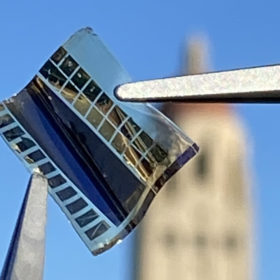
Flexible metal dichalcogenide solar cell with 5.1% efficiency
Stanford scientists have fabricated a transition metal dichalcogenide (TMD) solar cell that is claimed to overcome the typical issue of this kind of PV device, the so-called Fermi-level pinning. They used graphene contacts to mitigate this phenomenon and achieved a record power per weight of 4.4 W/g.

US bank to lend $500 million for First Solar’s 3 GW fab in India
The U.S. International Development Finance Corp. has offered debt financing to support a 3 GW module manufacturing facility that thin-film PV manufacturer First Solar plans to build in the Indian state of Tamil Nadu.

Deploying solar on curved metal roofs
Midsummer and Medacciai are developing a BIPV solution for curved metal roofs in southern European markets, through a five-year deal.

RTE Energy plans PV module factory for Australia
Australia’s solar PV panel manufacturing capacity is set to get a major boost, as Melbourne-based RTE Energy has confirmed that it plans to set up a large-scale heterojunction module factory in the state of Queensland.

Daqo fires up 35,000-ton poly fab
The polysilicon producer is sticking by plans to ramp up manufacturing capacity almost 300% within three years and says it will produce the basic material for the new generation of n-type solar panels.
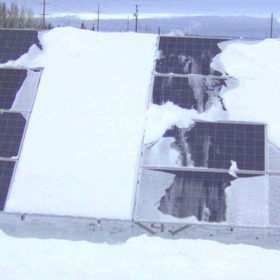
Icephobic surfaces for ice, snow shedding in utility scale solar
Developed by U.S. researchers, the proposed coating solution is claimed to effectively melt ice and snow with temperatures down to -35 degrees Celsius. It was fabricated by using medium-chain triglyceride oil to plasticize two common industrial polymer polyvinyl chlorides and tested at a pilot facility in Alaska.

EU prepares way for 0% VAT on several goods, solar panels for residential use now on proposed list
The European Council has approved a proposal to amend the EU rules on rates of value-added tax (VAT) to give member states more flexibility to set them. If adopted, solar panels for residential and ‘public interest’ applications would be included in the list of goods and services for which a maximum of 5% VAT could be levied.

NASA to test solar-powered propulsion for asteroid defense
NASA’s Double Asteroid Redirection Test mission will roll out solar arrays and an electric propulsion system to redirect Earth-bound asteroids.
