US start-up pursues roll-to-roll printing of perovskite on flexible glass
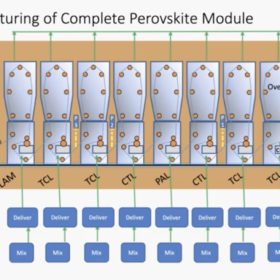
A Rochester-based firm aims to print perovskite and other PV layers on a flexible glass substrate using a roll-to-roll machine Kodak has used to produce photographic film.
AI model for accurate prediction of organic PV efficiency
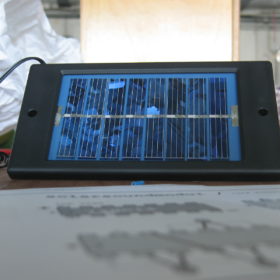
Over the last few months, Nastaran Meftahi has been spending her time in pandemic lockdown developing a machine-learning model to predict the future of next-generation organic solar cells.
Chinese PV Industry Brief: Longi, Jinko and JA Solar expect their combined capacity of 182mm modules will reach 54 GW next year
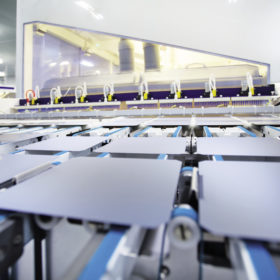
At a conference held in Shanghai last week, the three Tier-1 manufacturers explained that the entire Chinese PV industry will continue to adapt to the 182mm wafers over the next months.
Rectangular aluminum fins for PV module cooling
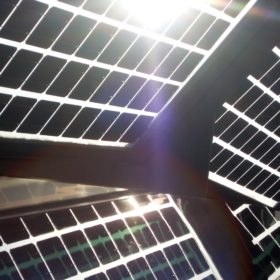
Scientists in Pakistan have proposed a new passive cooling technique which they claim can improve a module’s open-circuit voltage by up to 12.97% and its efficiency by up to 2.08%.
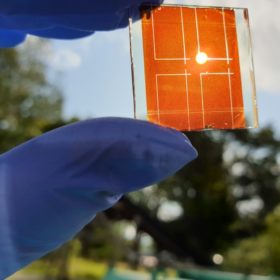
New tech to apply perovskite thin-film layers to conventional solar panels
According to its creator, Swedish start-up Evolar, the new technology can be applied to existing production lines for crystalline silicon modules and increase a product’s efficiency by around 5%.
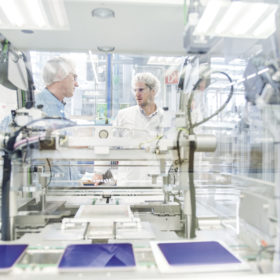
CEA-INES: ‘It is necessary and urgent to redefine system thinking about materials use in the PV industry’
CEA-INES, the French National Institute for Solar Energy, is gearing up to host the fourth edition of its ECO-PV workshop. Originally scheduled to be held this spring, Covid-19 has seen it pushed back to March 2021. Experts in the field of solar sustainability will present on, and discuss, “Photovoltaics: towards a sustainable industry”, with topics ranging from recycling, lifecycle assessment and European policy to manufacturing and the circular economy. In an interview, the institute speaks to pv magazine about the current state of solar sustainability and its goals for future work.

Chinese patent office rejects patent nullity proceedings against Hanwha Q Cells
Longi Solar had filed two lawsuits in China against the validity of two patents of the photovoltaic manufacturer from South Korea. Hanwha Q-Cells sees now a good chance of being successful in proceedings before the European Patent Office.
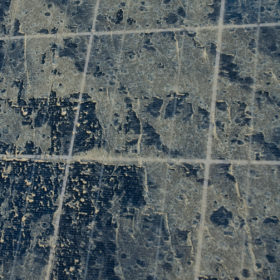
New panel cleaning tech based on nano-coating and mechanical vibration
Researchers in Egypt have tested a new solar module cleaning technique for solar arrays in arid regions. They claim that the combination of nano-coatings with vibration mechanisms on the backs of modules can reduce manual cleaning requirements.

‘Solar should be at heart of EU recovery’
Solarpower Europe has called on member states to put solar and battery storage front and center when it comes to drawing up the Recovery and Resilience plans needed to secure a slice of the bloc’s proposed €672.5 billion post-Covid stimulus package.

China could add 48 GW of solar next year – AECEA
The in-country analyst has revised up its expectation for this year and says a healthy unsubsidized project pipeline will keep the numbers ticking over in 2021. The spending plans necessary to ramp up renewables targets in the next five-year plan, though, could put the nation on a collision course with the EU.
