
Breaking news: Zhonghuan Semiconductor up for sale
The body responsible for state-owned assets in the Chinese port city of Tianjin has approved plans to sell all or part of the solar manufacturer to outside investors – although the rumored beneficiary is thought to be partially state-owned itself.
China holds firm on strategy to build self-sufficient domestic polysilicon industry
The Chinese government will extend duties on U.S. and South Korean polysilicon for another five years from today despite committing to buy $200 billion more American goods and services in the trade deal signed on Wednesday. Poly manufacturer REC Silicon says it expects polysilicon to form part of that trade agreement.
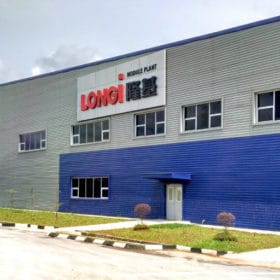
Longi claims 22.38% efficiency world record for PERC mono panel
The Chinese manufacturer said the result was confirmed by Germany’s TÜV Rheinland. The achievement beats the company’s previous record of 21.65%, set last month.
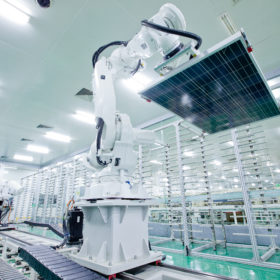
Jinko claims two more efficiency records for bifacial panels
The Chinese manufacturer has achieved conversion efficiencies of 21.82% and 22.49% for its p-type PERC and n-type HOT bifacial panels, respectively. The results were confirmed by Germany’s TÜV Rheinland.

Solargiga hits 10% revenue rise – on back of 48% more shipments
The Chinese manufacturer had to ship a lot more ingots, wafers, cells and modules to secure a modest rise in returns, according to its unaudited 2019 figures.
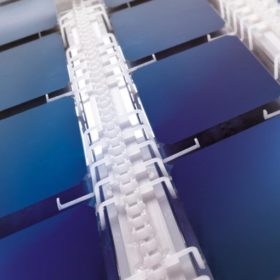
Singulus scores €50m CIGS production kit order from unit of China’s CNBM
The German PV equipment provider has agreed to supply manufacturing equipment for CIGS thin-film solar panels to the CNBM Bengbu Design and Research Institute for Glass Industry, a subsidiary of cement producer China National Building Material.
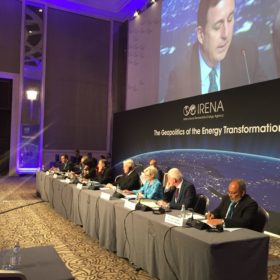
‘Renewables must grow four times faster to ensure sustainable future’
The share of renewables in the global energy mix must more than double by 2030 for the world to advance the energy transition and achieve sustainable development goals, according to the International Renewable Energy Agency. Renewable electricity should supply 57% of global power by the end of the decade, up from 26% today.

SolarPower Europe repeats call for solar strategy as part of European Commission’s €1tn Green Deal
Lobby group CEO Walburga Hemetsberger says the plans announced by commission president Ursula von der Leyen this week should place the European solar industry front and center.
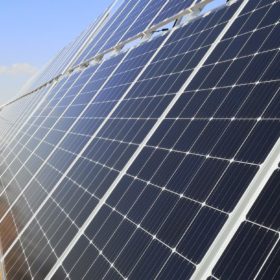
Jolywood says 105 MW Oman project demonstrates value of n-type
As it moves towards grid connection this month, the solar project in the south of Oman demonstrates the value proposition of n-type PV cell technology, Chinese solar manufacturer Jolywood has argued at the World Future Energy Summit. The project is said to be the largest n-type bifacial array in the world.
Hard times for thin-film PV module makers as Crystalsol and Calyxo file for insolvency
Calyxo, a German cadmium telluride solar module manufacturer, has filed for insolvency for the second time, despite the recent emergence of new prospective investors. Meanwhile, Crystalsol – an Austrian flexible solar panel maker – has also initiated insolvency proceedings, due to losses of roughly €7 million.
