
Tunisia to issue 300 MW tender for large-scale solar
The announcement was made by Prime Minister Youssef Chahed. The tender is set to be published on April 27.
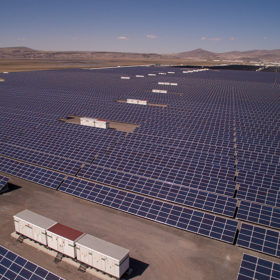
Record inverter shipments in 2017, three-phase string inverters overtake central for first time
According to the latest GTM Research statistics, global inverter shipments increased 23% in 2017, and revenues 11%, thus representing another record year. A market first, three-phase string inverter shipments overtook those of central inverters.
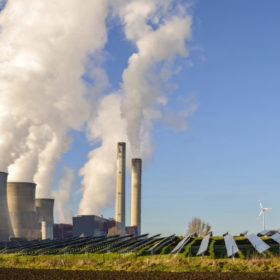
Solar outstrips fossil fuels in 2017 leading record renewables investment, report finds
A new report drafted by Bloomberg New Energy Finance (BNEF), the United Nations Environment Programme (UNEP), and the Frankfurt School-UNEP Collaborating Centre shows that global solar energy investments overshadowed all other forms of electricity generation in 2017. China is leading the pack of the world’s largest renewables investors, followed by Australia, Mexico and Sweden.
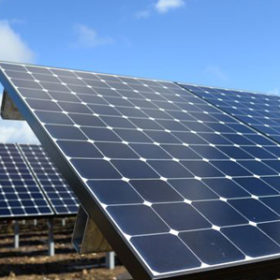
Engie wins Senegal’s 60 MW PV tender with bids under €0.040/kWh
The French energy giant will now build a solar PV power plant in Tauba, central Senegal, which will sell power at €0.0380 per kWh, while a second plant selling electricity at €0.0398 per kWh will be constructed in Kahone.
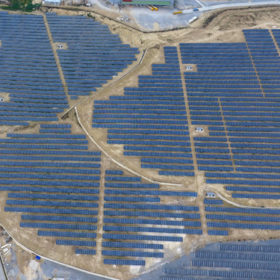
Turkey registers another 648 MW of unlicensed PV capacity in March
Since the beginning of 2018, newly registered unlicensed solar up to 1 MW has reached over 1.1 GW, while total cumulative capacity has topped 4.59 GW.

2018: India second largest solar market on back of 113 GW global installations
With 11 GW, India is set to become the second largest solar PV market in 2018, usurping the U.S., as global demand reaches 113 GW, says IHS Markit. It adds that Q4 will be the biggest quarter in history for installations, with 34 GW expected.
Solargiga unit to increase stake in PV module maker for $1.6m
Jinzhou Yangguang Energy (Jinzhou Yangguang), a subsidiary of China’s Solargiga Energy Holdings, has agreed to buy a 17.8% stake in Jinzhou Yangguang Motech Renewable Energy (Jinzhou Motech) from Motech Suzhou Renewable Energy for CNY 9.96 million (US$1.58 million), in a cash transaction.

Brazil allocates 806 MW of solar in A-4 auction, final average price drops to $35.2/MWh
Around 20 GW of solar PV projects were initially competing in the contest. PV was again the source with the largest share, accounting for around 80% of total assigned capacity. The final average price for solar was 118 BRL (US$35.2)/MWh.
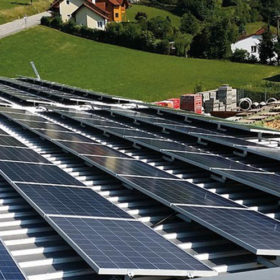
Austria plans to launch 100,000 solar roof program
The Austrian solar sector has welcomed the new draft plan for an integrated climate and energy strategy and, in particular, the planned “100,000 roofs program”. Greenpeace, however, believes a reorientation of climate policy is urgently needed and that the presented measures are inadequate to reach the Paris climate targets.

Batteries, inverters, solar cells safe from US Section 301 tariffs
The list of Chinese products that the Trump Administration is considering for duties under Section 301 spares inverters, solar cells and modules, and the lithium-ion batteries used in EVs and battery storage to accompany PV.
