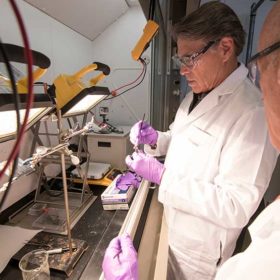
American scientists give PV a paint job
Berkeley researchers have discovered a shade of blue – dating back to ancient Egypt – which has impressive qualities they say could reduce building energy consumption and boost solar energy output. Meanwhile, the US National Renewable Energy Laboratory has developed a perovskite cell material that could be applied to a substrate using a paintbrush.
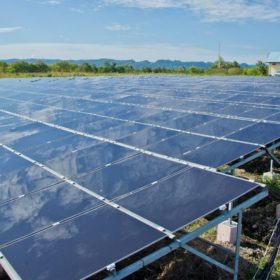
Micro and mini-grids to bring power to Indonesia’s off-grid communities
The government wants to help the provinces of eastern Indonesia – in particular Papua, which has the lowest electrification rate in the country. Policymakers are in talks with the Asian Development Bank and seeking advice for implementation.
Price of solar keeps falling in Lebanon
According to a report from the United Nations Development Programme, the turnkey price for solar in the nation declined by around 17.4% between 2016 and 2017 – and by 79% over the last seven years. By the end of last year, cumulative installed Lebanese PV capacity reached 35.4 MW.

Uzbekistan’s steeplechase towards renewable energy
French oil group Total has reached agreement with national utility Uzbekenergo to build a large-scale PV plant in Samarkand province. However, construction on a 100 MW project by China’s Syngyes has been suspended.
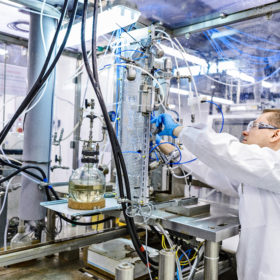
Innolith launches non-flammable battery with 50,000 charging cycles
Inorganic electrolytes will do the trick the company says. For multi-MW grid-scale applications the company says its technology can boost battery life to 50,000 cycles and is non-flammable. It adds that the costs of the product are competitive with conventional battery systems. Innolith is taking over the baton from Alevo, including chief executive and engineers. Alevo, however, went bankrupt last year, making the same promises.

Solar funding moves from companies to projects
Mercom Capital’s latest report shows sustained low levels of funding for solar companies, but strong investment in solar projects and many acquisitions.
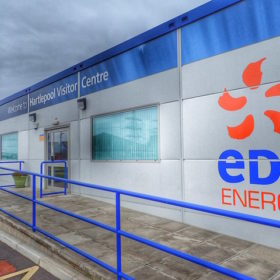
EDF now aims to become e-mobility leader
EDF has launched yet another ambitious plan, this time aiming to become the leader in e-mobility by 2022. It has outlined three targets, and cemented new partnerships, to achieve this goal.
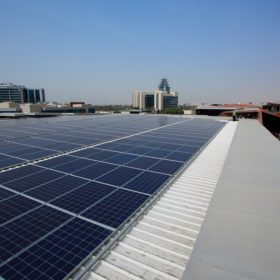
SirajPower develops 50 MW under DEWA’s Shams Dubai initiative
The UAE-based solar company has signed a 15 year lease for a 1.8 MW rooftop project on two warehouses of Apparel Group, a global fashion and lifestyle retail conglomerate.
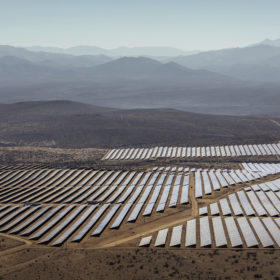
IEA low-balls solar growth (again)
The agency’s base case expects relatively flat growth in solar deployment over the next six years, but for solar to still dominate growth among renewable technologies. The agency’s estimates are again below those of major market analysts.
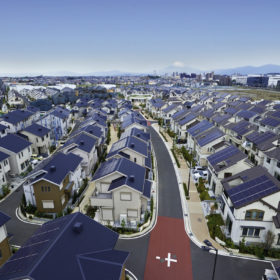
Japan to add 17 GW of new solar by the end of 2020 – Fitch
The additonal capacity is expected to come from the backlog of projects under Japan’s FIT mechanism and would raise cumulative installations to over 65 GW. In the period 2021-2027, however, the industry is expected to grow at a considerably lower pace, due to grid constraints, land availability and lower prices coming from auctions.
