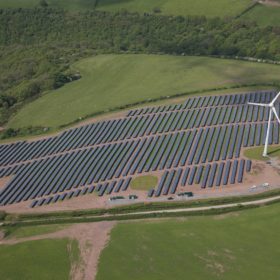
UK’s decarbonization depends on continued growth of EVs, RE, storage – National Grid
Outlining energy pathways for the next 30 years and beyond, the U.K.’s National Grid has released four different scenarios, considering growing electricity demand and a significant increase in energy infrastructure from new renewable generation and EV charging networks. Only two of them meet the U.K.’s 2050 carbon reduction target on the back of a large growth of renewables and energy storage, and almost completely decarbonized transport.
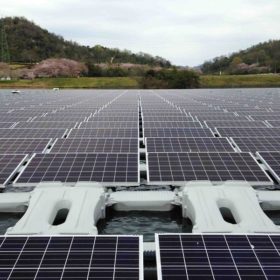
South Korea to set new PV construction rules after landslide destroys array
The South Korean government has revealed plans to introduce new environmental guidelines and rules on where PV projects can be built, following a public outcry after a landslide smashed into an operational solar array south of the city of Daegu.

Solar glass: European PV module manufacturers fear being “taken hostage”
Currently, new anti-dumping proceedings against solar glass makers from Malaysia are taking place in the EU. Imports of Chinese solar glass have been subject to high anti-subsidy and anti-dumping duties since 2014. The European module manufacturers fear further massive competitive disadvantages and the danger of an Interfloat monopoly in Europe.
Spain covers 45.8% of H1 2018 electricity demand with renewables
Spain’s electricity grid operator, Red Eléctrica de España (REE) has announced that the country’s mainland covered almost half of its electricity demand in the first half of 2018 with renewable energies alone.

US proposes 10% tariffs on inverters, AC modules, non-lithium batteries from China
As the trade war escalates, PV inverters, solar panels with attached microinverters and battery storage products other than those which utilize lithium-ion chemistry, may be the latest victims.

Setting the stage for solar + storage
As more states adopt ambitious renewable power and storage targets, hopes increase for continued market opportunities beyond the ITC. In the mid-term, the overall market opportunity is clear. At IHS Markit, we project 73 GW of solar PV systems will be installed in the United States from 2018 to 2022.

Distributed energy storage standards project launched in Australia
DNV GL, Deakin University, the CSIRO, and the Smart Energy Council have come together to collaborate on a two-year project to develop a new performance standard for distributed energy storage systems. The work behind the proposed Australian Battery Performance Standard is being funded $1.9 million from ARENA and the Victoria state government.
Solar corporate funding rises 15% YoY with $5.3 billion in H1 2018 – Mercom
Despite the uncertainty caused by U.S. solar panel import tariffs, deteriorating trade relations between the U.S. and China, and the looming consequences of China’s PV policy change, the solar industry saw a 15% YoY increase in corporate funding in the first half of 2018, on the back of a Q2 rebound, finds the latest Mercom Capital report.
Q4 could be a ‘hot market’ for solar contract negotiations following China’s changes – BNEF Q&A
In a Q&A with Bloomberg NEF (BNEF), two solar analysts tell pv magazine they see no PV module price rebound, continuing oversupply, and falling utilization rates. They expect Q4 could be a “hot market” for contract negotiations, while Chinese developers will start overseas construction earlier than planned for two key reasons.
Global EV market growing sturdily despite trade dispute setbacks
EnergyTrend recognizes recent tariffs developments will hit the electric vehicle (EV) industry. Despite this, environmental regulations, as well as costs and technological advancement, will prevail and continue to drive EV sales globally.
