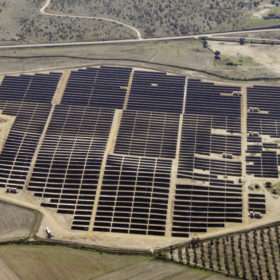
The weekend read: How does the EU taxonomy set criteria for technologies to be labeled green and provide investors with a classification system?
Despite its faults and shortcomings, the EU’s Taxonomy Regulation is expected to support the energy transition and help redirect capital flows to renewables and green assets. Andreas Walstad examines how the taxonomy sets out criteria for technologies to be labeled green and environmentally sustainable in a bid to provide investors with a classification system that boosts clarity, accountability, and predictability.
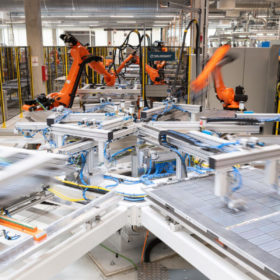
Solarwatt obtains ‘cradle-to-cradle’ certification for its glass-glass solar modules
The ‘cradle-to-cradle’ certification is considered a globally recognized holistic product quality standard. The assessment is made for five categories: material health, recyclability of materials, energy management and CO2 emissions, water management and social responsibility
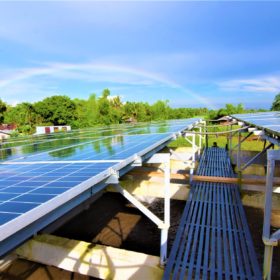
Fish farmed as part of solar-powered irrigation system
A provincial government in the Philippines has installed a solar pump that will move water to a reservoir where fish can now be bred. The $124,000 system will also irrigate vegetables and high-value crops for two farmers’ groups.

South Africa’s oldest wine estate goes solar
Small scale investors around the world have pledged cash to back a solar system to power winemaking and restaurant operations at the famous Groot Constantia estate.
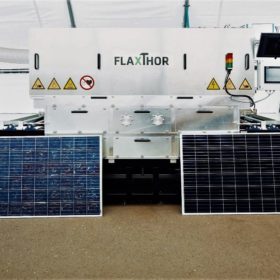
Industrial process for ‘mobile’ solar module recycling
German company Flaxres has developed an industrial process to recycle PV modules, and has begun operating a pilot facility at its new site where 10 tons of solar modules can be recycled daily. Flaxres plans to make equipment based on this facility available to international customers.
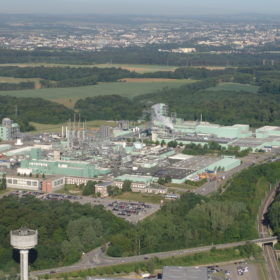
DuPont Teijin Films: Recycled PV backsheets are technically viable
UP Initiative sponsor, DuPont Teijin Films is investigating closed loop recycling processes, specifically looking at how its backsheets can be recovered and used as a raw material for new production. Since 2020, it has been working on industrial trials with customers to offer rPET backsheets across its entire product range, and proof of principal trials to demonstrate the commercial feasibility of a true closed loop recycling process. pv magazine caught up with Steven Davies, EMEA market manager to discover what progress has been made in the last year.
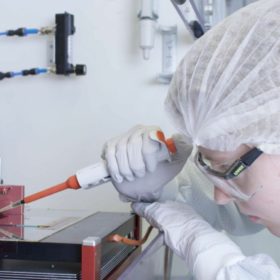
Eco-friendly solvent for a 16.7% perovskite solar cell
Scientists in Germany looked to eliminate the use of toxic solvents in the production of perovskite solar cells, replacing them with a more environmentally material called dimethyl sulfoxide (DMSO) which has so far proved difficult to integrate into processes suitable for large-scale production. The group demonstrated a scalable blade coating process using DMSO as the only solvent, and reached cell efficiencies close to those achieved using more toxic substances.

pv magazine Roundtables: Videos on solar everywhere, PV manufacturing trends, risk sharing in PPA markets, and green hydrogen
On day two of the pv magazine Roundtables Europe event, we focused on minimizing land competition for PV with dual use applications, how high efficiency n-type cells are progressing toward large-scale manufacturing at competitive cost, PV module design choices, how unsubsidized power purchase agreements can adapt and evolve, and the determining conditions for solar-plus-storage and solar-plus-hydrogen business models, among other key PV issues. The last five sessions are now available to view on demand.

pv magazine Roundtables: Videos on EU manufacturing, solar sustainability, decarbonizing homes, and PV on wheels sessions
With a strong focus on solar and battery energy storage and their role in decarbonization right throughout the European continent and economy, this year’s pv magazine Roundtables Europe focused on how green electrons, jobs, and manufacturing can deliver a cleaner, freer future for Europe. The first five sessions are now available to view on demand.
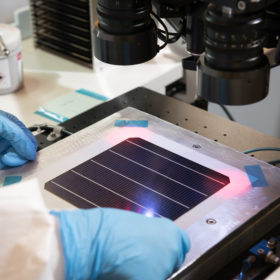
Environmental impacts of perovskite PV
A life-cycle analysis of perovskite-silicon tandem modules indicates that additional environmental impacts in manufacturing are more than offset by the higher energy yield over their lifetime.
