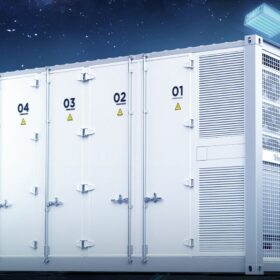
Trina Storage releases 4.07 MWh energy storage system
Trina Storage has developed a 4.07 MWh energy storage system featuring its in-house 306 Ah lithium iron phosphate battery cells, configured with 10 racks of four battery packs.
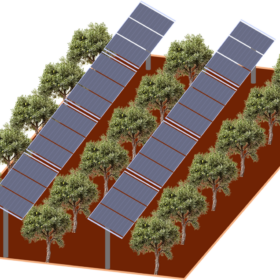
Bifacial agrivoltaics for olive groves
A Spanish-Italian research team has investigated different system configurations for bifacial agrivoltaic solar arrays deployed in olive groves and has found that the solar modules’ tilt angle has a significant impact on power yield while their height plays a crucial role on increasing agricultural yield.
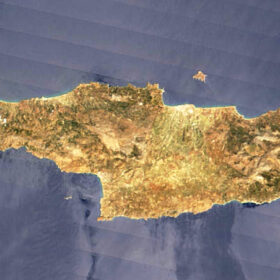
Crete-Greece subsea link secures €250 million of EU funds
The European Commission says Greece’s new subsea electricity interconnection linking the island of Crete to mainland Greece will receive more than €250 million ($269.3 million) from the European Regional Development Fund (ERDF).
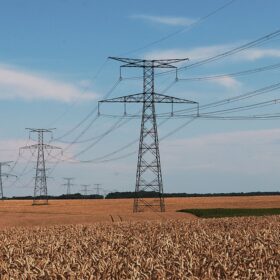
Romania proposes auction-based grid connections for plants above 1 MW
Romania’s Ministry of Energy has published a draft order outlining a move to an auction-based grid-connection process for solar projects above 1 MW in size. The change, which is currently subject to public consultation, could be implemented from January 2025.
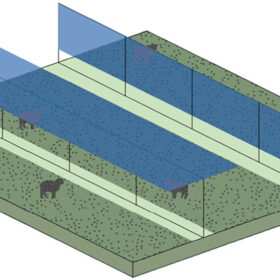
Overhead vs. vertical agrivoltaics
A survey conducted by Dutch researchers has compared the visual impact of overhead and vertical agrivoltaics farms on nearby residents and has found that vertical arrays look less invasive.

Dubai’s high-rise buildings perfect match for building-integrated photovoltaics
Scientists in the Middle East have simulated the use of different building-integrated PV systems on Dubai’s high-rise buildings. They found that for buildings with more than seven floors, BIPV may be superior to rooftop power generation.

End of load shedding ‘finally within reach,’ says South African president
South African President Cyril Ramaphosa says the country has overcome the worst of its power shortages due to tax incentives, investment, the expansion of rooftop solar capacity, and the construction of new transmission lines, despite additional recent power cuts by utility Eskom.
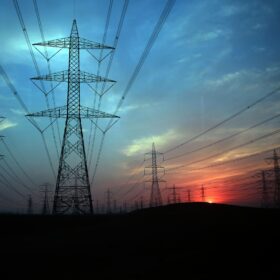
Optimizing photovoltaic grid integration through active power management
PV systems, surpassing minimum load demands in various regions, necessitate innovative grid integration measures. Active power management (APM), notably curtailment, emerges as a powerful solution here. By actively managing power peaks, PV systems can unlock new possibilities, contribute to grid stability, and enhance their overall value. The new IEA-PVPS Task 14 report encourages a shift in perspective, urging DSOs to explore the potential of APM instead of traditional grid expansion methods.
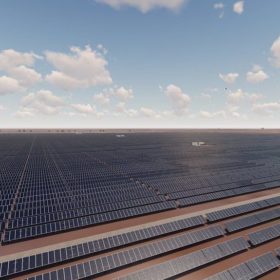
Australian energy modeler installs power-management tech at defense sites
Proa, an energy forecasting company, is rolling out its technology at solar farms at two national defense facilities in northern Australia, with positive implications for scheduling solar energy commitments with certainty.
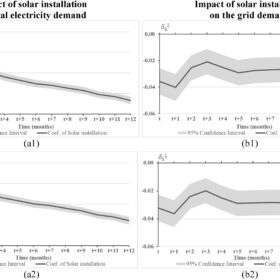
The solar rebound effect in residential PV
The rebound effect consists of a reduction in expected gains from a more resource-efficient technology as a result of behavioral or systemic change. An international research team has investigated this phenomenon in the residential PV segment in Vietnam and has found that it could happen in any country where the policy supporting solar power is not fully and scientifically explained.
