
UK deals for vanadium redox flow merger and electric vehicles announced
English partners appear to be in demand with a London-based vanadium flow supplier tying up with a U.S. partner just as an automotive design company in Coventry announces plans for electric and hydrogen vehicle production in the West Midlands.

New fractal solar panels combine efficiency and aesthetics
Researchers from the United States have proposed a new electrode design for fractal solar panels that combines the typical aesthetic advantages of the technology with the efficiency of busbar design. The proposed pattern is based on the fractal tree structure known as H tree, or T-branching, which is a geometric shape consisting of a repeating pattern that resembles the letter H. The hybrid H-tree/busbar pattern showed power losses that are close to those of standard busbars.
Sector coupling in Europe could see solar and wind demand double
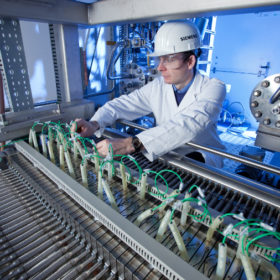
Market intelligence firm BloombergNEF has published a report with power company Statkraft and clean energy distributor Eaton highlighting the importance of sector coupling for Europe’s decarbonization plans. Analysts examined the power markets of Germany and the U.K. and concluded effective sector coupling including the use of green hydrogen could lead to greenhouse gas emission reductions of 83% by 2050.
Cheaper flow batteries with new membrane
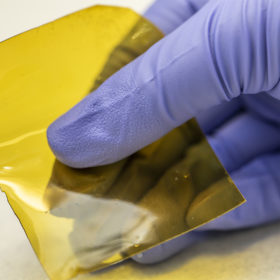
US scientists claim to have discovered a membrane which could lead to cheaper large scale flow batteries. The material is an ion-selective, aqueous-compatible polymer with intrinsic microporosity known as AquaPIM and is said to have tunable thickness and high conductivity in aqueous electrolytes.

Hydrogen is the first viable option for seasonal storage
Compressed hydrogen is “the first viable option” to help meet wintertime electricity demand in a high-renewables grid, says DNV GL.

New technique to improve titanium dioxide films in dye‐sensitized solar cells
Dutch scientists are producing mesoporous titanium dioxide thin films at room temperature by using the papain enzyme in a dip‐coating procedure. This fully organic process could facilitate the development of cheaper, more efficient dye‐sensitized solar cells.
Solar windows made of chromophores
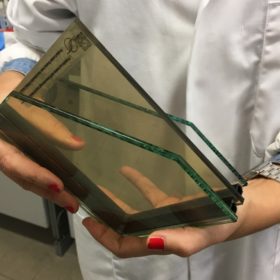
An Italian startup has developed a luminescent solar concentrator technology that can be integrated with active architectural elements and windows. The technology is based on nanoparticles known as chromophores, which decouple the absorption and light-emission processes, thanks to appropriate engineering. The company claims it has achieved a conversion efficiency of up to 3.2%, with a degree of transparency in the visible spectrum of around 80%.

Hybrid tandem quantum dot solar cell with 12.8% efficiency
South Korean scientists have produced an organic, hybrid-series tandem PV device that combines quantum dots and organic bulk heterojunction photoactive materials. They claim that the cell has the highest efficiency among all reported colloidal quantum dot cells, including single-junction devices and tandem devices.

Netherlands’ largest power provider makes room for more solar
Liander will apply a grid congestion management system in the Gelderland province from the autumn. The measure is intended to reduce the number of solar and wind power projects waiting on new grid capacity.

Lithium-sulfur solid-state batteries promise fire safety at high performance
The scramble for new battery solutions is accelerating as researchers from Singapore tout an electrolyte which which they say produces highly stable lithium-sulfur batteries that maintain performance metrics – a task which has proven tricky thus far.
