Hydrogen to play limited role in building energy supply
How much hydrogen is actually needed? Several German research institutes have examined 40 energy scenarios for hydrogen ramp-up and found that 15 million GWh of hydrogen will be needed worldwide by 2050.
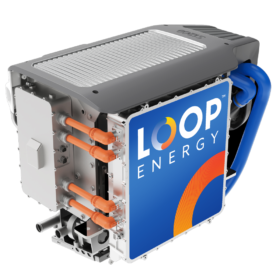
The Hydrogen Stream: Canadian startup unveils 120 kW fuel cell system
In other news, Alstom tested its hydrogen train for long-distance transportation and the IEA released a report suggesting that hydrogen development may require an annual investment of around $60-130 billion through 2030.
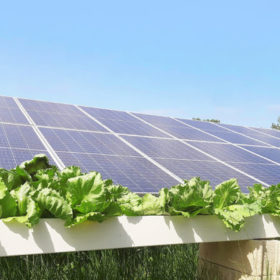
Q Energy France unveils pilot PV system for hydroponics
The prototype system covers an area of 250 m² and is equipped with a rainwater recovery system. Q Energy France and its partner Aquacosy are now looking for land for a larger project.
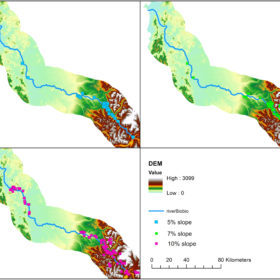
Pumped hydro storage for rivers, coastal lines
Scientists in Germany have developed a new methodology to identify suitable areas for pumped hydro storage projects close to rivers or shorelines. Their new method considers parameters such as the minimum required flat area for the reservoir, the allowable slope of the terrain, the minimum head, and minimum required head to distance ratio between two reservoirs.

Cadmium-free kesterite solar cell with 9.7% efficiency
Researchers in China developed a new kesterite solar cell they say has improved efficiency and stability. The device was able to retain around 90% of its initial efficiency after 100 days without encapsulation.
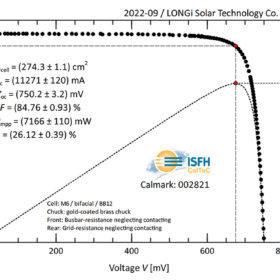
Longi achieves 26.12% efficiency for gallium-doped p-type heterojunction solar cell
The result, confirmed by Germany’s Institute for Solar Energy Research Hamelin (ISFH), was achieved on a heterojunction solar cell based on an M6 wafer.
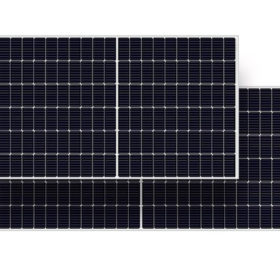
Jinergy unveils all-black solar module series for rooftop PV
The all-black series includes a monofacial PERC module with an efficiency of up to 20.86% and an n-type heterojunction product with an efficiency of 21.68%. Both products feature all-black integrated design, with black backsheet, black busbar, black frame and black encapsulant material.
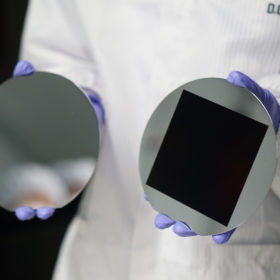
Wafer scale microwire solar cell with 21.1% efficiency
Korean scientists have built a wafer scale radial junction solar cell with tapered microwires and a surface passivation layer made of aluminum oxide. The device showed the highest power conversion efficiency among the previously reported microwire solar cells.
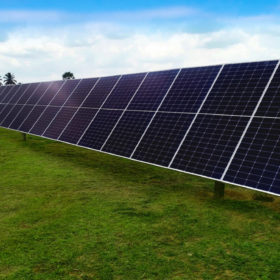
FTC Solar unveils new self-powered tracking system
United States-based engineering firm FTC Solar has unveiled a new self-powered solar tracking system which it says requires up to 36% fewer foundations than existing technologies and enables an estimated 5% greater energy output for a given parcel of land.
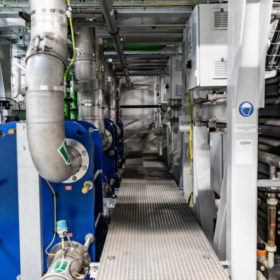
The Hydrogen Stream: Siemens commissions 8.7 MW electrolyzer in Germany
As Siemens commissions Germany’s second largest electrolyzer at the Energy Park in Wunsiedel, Engie has taken the Final Investment Decision for a project in Western Australia, scheduled for completion in 2024. Meanwhile, two reports shed light on the future of green hydrogen: on the demand side, the MENA region could use it to become the global leader of green steel; on the supply side, BNEF welcomes the support commitments coming from Europe and the United States.
