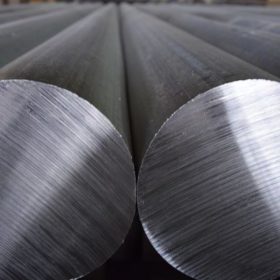
Long-term, heat-based energy storage in aluminum
Nine partners from seven European countries are involved in the €3.6 million ($3.7 million) “Reveal” research project, which says buildings could be heated in the future by storing energy from PV, wind and water in aluminum.
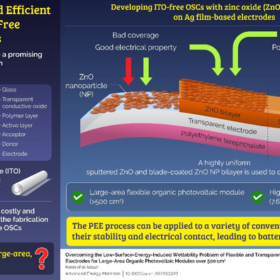
ITO-free organic solar cells for large modules
Researchers in South Korea have reported success in developing large-area, indium tin oxide-free, flexible organic solar cells. Their zinc oxide bilayer-based organic solar cells demonstrated an efficiency of 7.67% for a module area of 528 square centimeters.
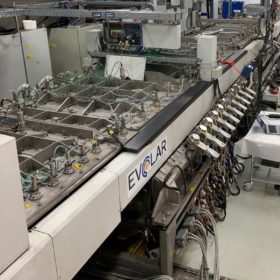
Evolar claims 25-year stability for perovskite cells
Evolar, a Swedish manufacturing startup, has put its perovskite cell technology through industry-standard accelerated reliability testing. It said its results show that the cells would likely remain stable for more than 25 years in the field.
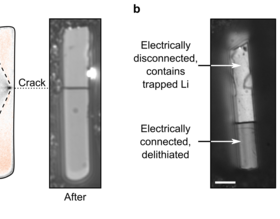
Optical microscopy technique to study prevention of battery failure
Researchers at the University of Cambridge have examined one of the fastest-charging anode materials by using a low-cost, lab-based optical microscopy technique. Their findings showed that particle fracture, which can reduce the storage capacity of a battery, is more common with higher rates of delithiation and in longer particles.
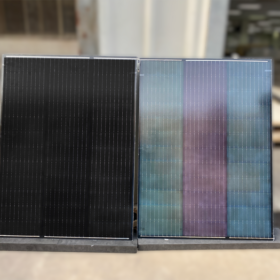
High-efficiency colored BIPV panels
Researchers in China have reported a colorization strategy for solar based on photonic glass. They created solar panels that took on blue, green, and purple hues, while only dropping the efficiency of power generation from 22.6% to 21.5%.

The Hydrogen Stream: Guangdong targets €4.35/kg retail price by 2025
The authorities in China’s Guangdong province have released a 2022-25 plan that foresees the retail price for hydrogen dropping to less than CNY 30/kg ($4.42/kg). Germany and Canada, meanwhile, are set to strengthen their collaboration on hydrogen, and Ford has revealed plans to team up with Southern California Gas for a hydrogen fuel cell electric truck that will be on the road by 2025.
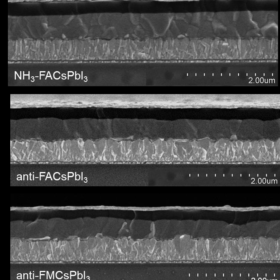
Healing defects with ammonia for a 23.21% efficient perovskite solar cell
Scientists in China demonstrated a process to “heal” defects in a perovskite film by using an ammonia treatment after the film is formed through a solvent process. Small solar cells made using these films achieved maximum efficiency of 23.21%, while a mini-module with a 14-square-centimeter active surface area reached 20.61%.

New platform centralizes PPA market data
LevelTen Energy, a renewables transaction infrastructure company, has launched a new platform to simplify and accelerate power purchase agreement market analysis. The new platform, MarketPulse, provides 24/7 access to PPA price data, renewable energy project data, and analytics.
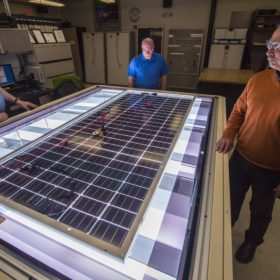
Monitoring degradation for 13 module types
In a study that began in 2016, US scientists purchased 834 PV modules, representing seven manufacturers and 13 module types, and installed them in various climate conditions to observe their performance over time. The results show that, while plenty of opportunities still exist to extend module lifetimes and reduce performance loss in the field, reductions in the manufacturing cost of PV have not come with an increase in their degradation rate.
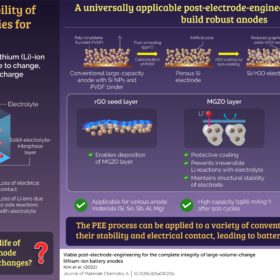
Universal method to improve lifespan of lithium-ion batteries
Researchers at the Gwangju Institute of Science and Technology (GIST) have developed a broadly applicable and versatile post-electrode-engineering process. It can be applied to a range of conventional anodes to improve their stability.
