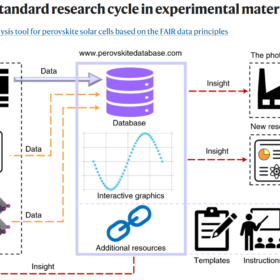
The Wikipedia of perovskite solar cell research
An international team of researchers has collected data on metal halide perovskite solar cells from more than 15,000 specialist publications and made them available in an open-access database. The Perovskite Database Project is based on the FAIR data principles that data should be findable, accessible, interoperable, and reusable and aims to capture the rapid development occurring in this increasingly relevant research field.
A year in PV: Technology trends in 2021
The PV industry in 2021 has largely been defined by disruption: Price increases from raw materials to final shipping have led to shortages in PV module supply and project delays the world over. Despite these upsets, innovation has continued at pace, and the year has seen plenty of technological twists and turns that are sure to spell good news for solar in the long run. Read on for a look back at some of the biggest developments.
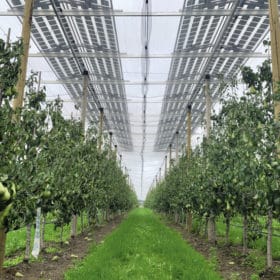
Stepping UP in 2021: #1 How agri-PV could address two of the biggest sustainability challenges of our times
2021 marked the second year of pv magazine’s UP Initiative where we shined a spotlight on sustainability in the solar industry. Over the course of 12 months, we focused on four key issues. First up was agrivoltaics – the combination of agriculture and solar energy – in recognition of this emerging market. The goal was to understand the potential benefits and economic, political, and technical challenges of such an innovative partnership. Read on to discover our coverage from this quarterly theme and watch out over the coming days for the topics of Workers’ rights, Sustainable electricity and corporates’ critical solar role, and Urban Solar.
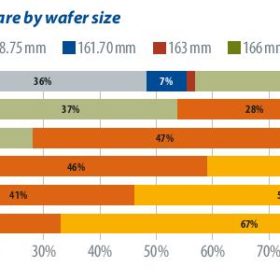
A 200 GW solar year in 2022
Structural imbalances in the supply chain and the energy intensity and consumption controls that China imposed in late September have caused prices for most PV module materials and components to continue to rise. Shipping fees and PV plant construction costs also remain high. PV plants in many regions will therefore be postponed until next year, but it remains unclear when module prices will start to fall. Despite these challenges, the global race to cut carbon emissions continues, and InfoLink’s Corrine Lin forecasts a bright future for PV deployments in 2022.
The Hydrogen Stream: Big push from Iberian peninsula
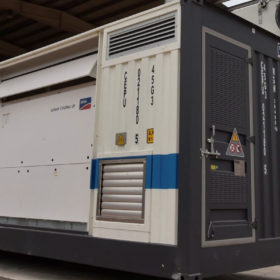
A Spanish consortium has started commissioning tests to produce renewable hydrogen in Mallorca, while another consortium led by Portuguese energy giants EPD and Galp is set to develop 100MW of green hydrogen production in Sines, Portugal. Lightsource bp and Dourogás have also agreed to set up a joint venture to invest in solar and green hydrogen infrastructure in Portugal.

Chinese Industry Brief: CATL inaugurates 120 GWh lithium-ion battery factory
The lithium-ion battery producer began manufacturing activities at its new factory in Ningde city, Fujian Province. Aiko Solar has also secured 4,515,000,000 wafers for the next three years through three different supply deals.
An overview of heterojunction solar cell technologies
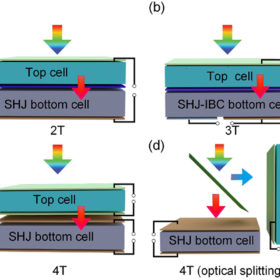
Scientists at the Nankai University in China have provided a comprehensive overview of current research on silicon heterojunction-based tandem solar cells (SHJ-TSCs) and shared their expectations of future developments in this field.
Risen claims 23.65% efficiency for heterojunction solar module series
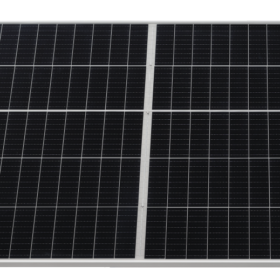
The module series also achieved a maximum power of 721.016 W. The result has been confirmed by TÜV Rheinland.
Damaging defects in silicon solar cells
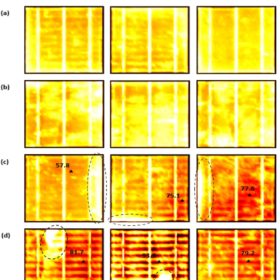
Scientists in the UK investigated the relationship between two of the most worrisome defects that can affect solar cells in the field – cracking and hotspots. Their work analyzed solar cells with different levels of cracking under varying light conditions, finding that the most severely cracked cells were considerably more likely to run at high temperatures and form damaging hotspots.
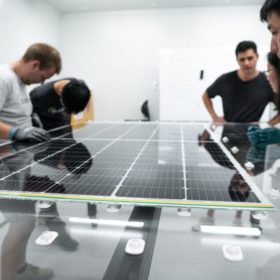
Australian startup SunDrive fabricates its first full-sized panel
Sydney-based startup SunDrive has given itself an early Christmas present in the form of the fabrication of its first full-sized panel. This panel marks the most recent milestone on the road to commercialization for SunDrive, which set a new world record for commercial-sized silicon solar cell efficiency in September.
