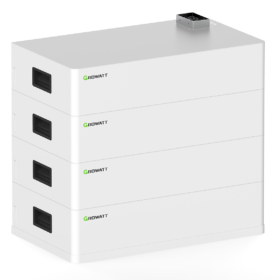
Growatt releases battery for off-grid solar
Growatt’s new AXE LV battery covers a wide range of capacities, from 5kWh to 400kWh, and can support off-grid systems with power outputs of 3kW to 30kW.
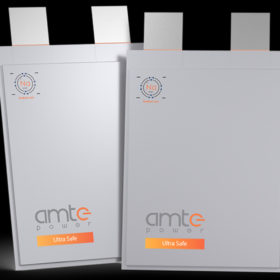
Sodium-ion battery tech gets commercial testing in UK
Harwell Campus will provide a testbed for energy storage technologies coming from three U.K.-based innovative businesses, bringing their solutions one step closer to the market.
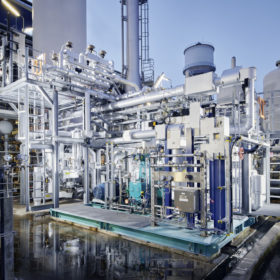
The Hydrogen Stream: World’s first full-scale pilot plant for extracting hydrogen from natural gas pipeline
Germany-based Linde Engineering has started up a full-scale pilot plant in Dormagen to showcase how hydrogen can be separated from natural gas streams using its membrane technology. Furthermore, Abu Dhabi-based renewable energy developer Masdar has teamed up with French energy giants Engie and Totalenergies on two separate hydrogen projects and Sweden’s nuclear power company OKG signed its first contract with an external buyer to enter the hydrogen market as a producer and supplier.

Australia to make world’s-first liquefied hydrogen shipment to Japan
The Suiso Frontier cargo vessel docked at Victoria’s Port of Hastings on Friday to take on the world’s first shipment of liquid hydrogen. The ship’s arrival is a landmark for the Japanese-Australian Hydrogen Energy Supply Chain pilot project, which sees liquefied hydrogen generated from brown coal, and an engineering milestone in itself. But while the Australian government describes the product as “clean”, experts maintain that carbon capture and storage technology has proven only to be an expensive failure.
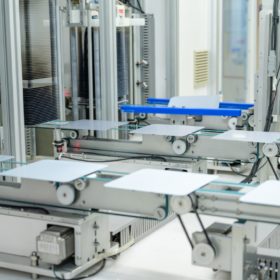
Chinese solar industry may reach 500 GW module capacity by year end
According to Asia Europe Clean Energy (Solar) Advisory (AECEA), this huge capacity may not be met by actual demand in the global market. Furthermore, the consultancy reveals that solar module prices should reach a price level of up to RMB 1.75 ($028)/W by the second half of the year, and that in 2021 new PV additions totaled 53 GW with more than half of this capacity being delivered by distributed generation.

Photovoltaic-thermal panel from China
Developed by Chinese specialist SolarMaster, the panel is sold in four different versions with photovoltaic output ranging from 340 to 545 W and solar thermal output of 910 to 1,436 W.

How artificial intelligence can be used to identify solar panel defects
Solar farm operators are turning to AI-powered inspection to speed up the inspection process and improve accuracy. They use algorithms that can automatically detect solar panel defects from images.
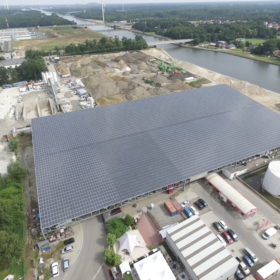
Economic and technical feasibility of a storage-as-a-service model using second-life batteries for a commercial end-user
As part of the EU Horizon 2020 CIRCUSOL project, Belgian PV installer and investor Futech investigated the technical and economic feasibility of integrating a second-life battery storage system at an existing 2MW solar plant in Belgium. The system originates from the automotive industry and was successfully commissioned in August 2021.
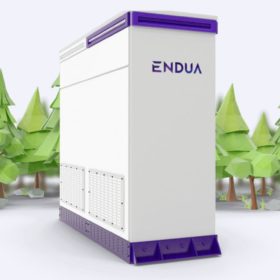
Australian startup gets funds to commercialize modular hydrogen-powered energy solution
Australian startup Endua’s plan to make modular hydrogen-powered energy generation and storage systems has been given a financial boost, as the federal government has provided it with almost AUD 1 million ($719,800) to help it commercialize its technologies.
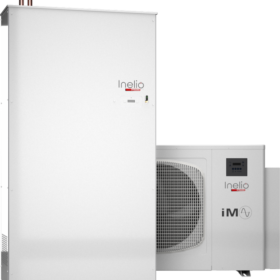
Residential heat storage system uses PV electricity for space heating, hot water
France-based FHE Group has developed a 2.5 kWh storage device that can store electricity as heat during the day and release this heat at night to power a heat pump for space heating and hot water. According to the manufacturer, it can retain over 95% of its initial performance after 20,000 cycles.
