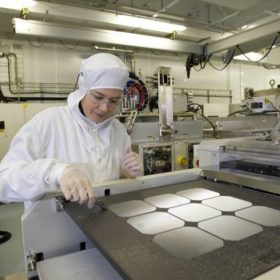
Ultra-thin silicon layers for 22.2%-efficient heterojunction solar cell
Scientists in the Netherlands fabricated a heterojunction solar cell with a layer of hydrogenated nanocrystalline silicon just three nanometers thick. The cell’s efficiency was measured at 22.2%, below the highest achieved with HJT cells, however, the researchers note that successfully incorporating this material into the cell stack will open many new doors for improvement.
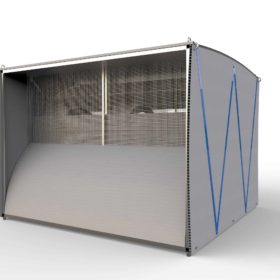
Hybrid wind-solar generator for rooftop applications
French startup Wind my Roof has developed a new wind power system equipped with two rooftop PV modules. It is currently testing a prototype in Paris.
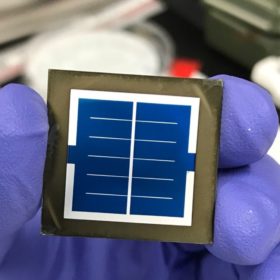
KAUST achieves 28.2% efficiency for perovskite/silicon tandem solar cell
Saudi Arabian scientists have developed a perovskite sub-cell of a tandem device with a molecule that prevents the migration of ions into the perovskite film, even under humid conditions. The solar cell has an efficiency of 28.6%.
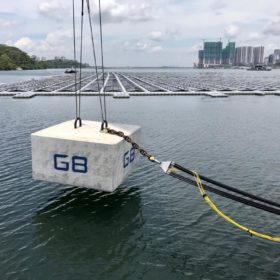
Singapore floating PV company targeting offshore expansion
Floating PV is a growing niche in the solar sector, but its offshore segment has proven more difficult to activate, largely because of the difficulty of open-water energy generation. Nevertheless, one company in Singapore, G8 Subsea, aims to leave the safety of harbors and reservoirs.

New tool to understand component failure rate in PV-related fires
Scientists have developed a new model based on fault tree analysis to evaluate the frequency of fires caused by rooftop PV systems and assess system safety and reliability. They claim that the new tool has the potential to identify fault linkages in systems, highlight failure patterns before they arise, and compare multiple designs for safety.

Fast charging for lithium-ion batteries needs a fix
Scientists in the United States placed fast charging for lithium-ion batteries under the microscope, finding that charging at higher rates can quickly damage the structure of a graphite anode, causing capacity loss even after a small number of cycles. By identifying the mechanisms causing this performance loss, the group can help point future research in the right direction.

Cost optimal solutions for residential solar-powered heat pumps in cold climates, isolated areas
A U.S.-Swedish research group has investigated the complex economic relationship between PV and heat pumps in cold climates under four different levels of electrification. It found that, compared to propane, solar heat pumps can reduce reduce costs by up to 20% and carbon emissions by 30%.
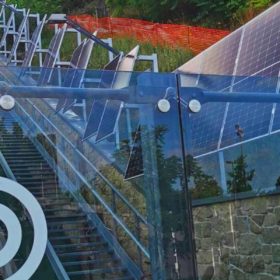
Solar-plus-storage powers urban elevator in Italy
The elevator is powered not only by the solar array and the batteries but also by the energy produced by the elevator itself while it is moving, through gravitational storage.
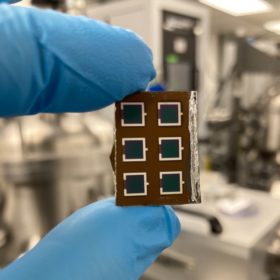
Antimony selenide solar cell with 8.5% efficiency
U.S. scientists have fabricated a cell via a two-step closed space sublimation process and by applying a seed layer to a soda-lime glass substrate coated with molybdenum via rapid thermal evaporation. They claim this facilitated the growth of a high-quality Sb2Se3 absorber layer with high crystallinity and large columnar grains.
Illustrating the n-type advantage
In a new white paper, Chinese PV manufacturer JinkoSolar demonstrates how its latest ‘Tiger Neo’ module, featuring the 182mm n-type TOPCon cells, achieves lower energy costs. Based on total project costs for various scenarios in China, the Middle East and Europe, Jinko calculates advantages arising from both the cell technology and its chosen wafer format.
