
Minute to design it: Solar design apps save time creating proposals for owners
In a sales environment where only one in 10 viable solar projects moves forward, getting from a good idea to a firm decision by a customer needs to happen fast. Here’s how one commercial solar installer makes technology work.
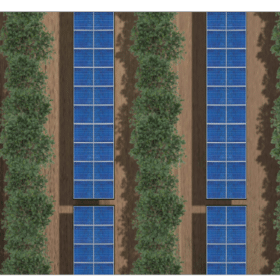
Integrating big solar into olive groves
German energy company Steag wants to build three PV plants totaling 244 MW across several olive groves in the southern Italian region of Apulia. The unsubsidized agrivoltaic projects are expected to sell electricity through power purchase agreements. The distance between the rows of the olive grove and the photovoltaic system has been specifically designed both to avoid shadowing and allow the passage of the automatic machinery necessary for the cultivation of the olive trees.
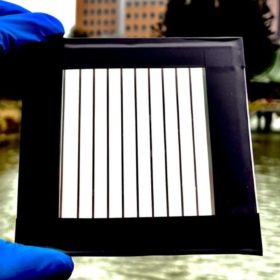
New manufacturing tech for 16.06%-efficient mini perovskite solar modules
A US-Taiwanese research group has created a new spin coating method which they claim can be applied in the mass production of mini perovskite panels. The scientists used sulfolane as an additive in the perovskite precursor to convert the perovskite phase via a new reaction route. They demonstrated a mini-module with a power conversion efficiency of 16.06% and an active area of 36.6 cm2.

PV-thermal technology earns tick of approval from IEA
Solar module developers have long recognised the detrimental effects heat has on cell performance but West Australian company Sunovate has pointed to solar PV-thermal (PVT) technology as an opportunity to value add by improving efficiency.
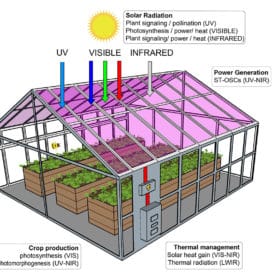
Growing lettuce in a solar-powered greenhouse
Scientists in the United States have analyzed how semitransparent organic solar cells placed on the roof of a greenhouse may impact crop production. They assessed, in particular, how solar power generation may affect lettuce crops and found that the plants not only grow unhindered but also that the solar cells reduce overheating in the greenhouse.
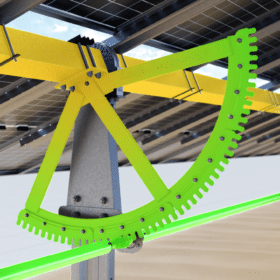
Special tracker for agrivoltaics
German tracker manufacturer Ideematec has adapted its Horizon L:TEC tracker for a series of agrivoltaic projects totaling 100 MW that will be developed in France by Spanish developer Amda Energía. The new tracker is claimed to be able to operate synergistically with the agricultural equipment.

Italy launches ‘hydrogen valley’ to strengthen supply chain
Italian research agency ENEA is planning to build a €14 million ‘hydrogen valley’ in the province of Rome. pv magazine has spoken with its director of the department of energy technologies and renewable sources, Giorgio Graditi, and has found out that the project will also include the production of hydrogen from photovoltaics.
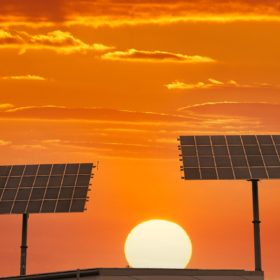
Holographic film to protect solar panels from overheating
Russian scientists have developed a holographic film based on prismatic concentrators that reduces the operating temperature of solar panels, including thermal-photovoltaic devices. They claim the patented, low-cost technique can even improve PV module efficiency in cloudy weather.
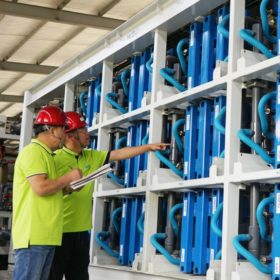
Canadian start-up wants to build gigafactory for vanadium flow batteries in China
The factory will be built by VRB Energy in the Hubei province, where it also wants to deploy a 100 MW solar park linked to a 100 MW/500 MWh vanadium flow battery.

Organic PV module with 12.36% efficiency
Chinese researchers have taken a quaternary approach to fabricate a module with an area of 19.34 cm2, a geometrical filling factor of 95.5%, and an efficiency of 12.36%.
