
African governments doing too little to drive clean energy
Covid-19 rescue measures such as delaying electricity bill payments pile added pressure onto energy companies already hit by pandemic-related falls in demand in a continent which a new study suggests is too dependent on donor aid for the development of renewables.
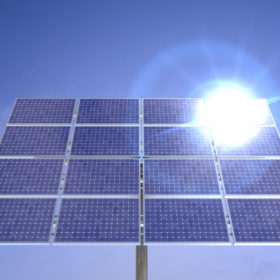
The best PV module cooling technique
An international research team has analyzed all existing cooling technologies for PV panels and has indicated the current best options and future trends of research. According to its findings, active water cooling, although expensive and not particularly practical, is the most effective cooling technique while passive cooling systems, despite being easy to apply, have still limited possibilities.
A chemical tune up for better perovskites
Scientists in the United States took a closer look at the way charges move through a perovskite material, and found that replacing hydrogen in the material with a heavier isotope can both reduce thermal conductivity and increase carrier lifetime, potentially leading to more efficient solar cells. And the group expects continuing study of charge states and molecule dynamics to yield further important discoveries.

Canadian Solar preps to launch 600+ W module
Bigger PV module designs are now hitting the market, but the production of larger, more powerful solar panels is challenging. Canadian Solar is launching its new Series 7 modules with pv magazine in a webinar on Oct. 29. Our editorial team recently caught up with Canadian Solar’s chairman and CEO, Shawn Qu, and director of module R&D, Alan Xu, to discuss the company’s latest efforts to shake up the market.
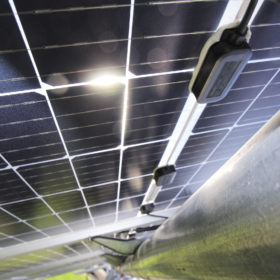
Bayesian algorithm to reduce LCOE of bifacial projects
German researchers have proposed a new model, based on a range of parameters, to influence the LCOE of bifacial PV plants, with a focus on components, land costs, inclination angles, albedo, and weather conditions.

France to support BIPV solar tiles with additional incentives
Barbara Pompili, the French minister of ecological transition, recently announced new bonus incentives for BIPV projects during a visit to a Sunstyle factory that aims to produce 1 GW of “Made in France” solar tiles by 2025.
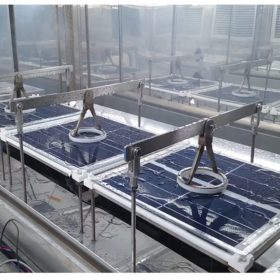
A stress test for all seasons
Scientists led by the U.S. National Renewable Energy Laboratory (NREL) have developed a new stress testing protocol for PV modules, one designed to simultaneously expose modules to multiple stresses, as they likely would be in the field. Putting modules through this test, the researchers have already been able to reveal new information regarding backsheet degradation, and they promise new insights into other degradation mechanisms both known and unknown as well.

New method to measure solar-powered hydrogen production
Indian researchers have used an “adaptive neuro-fuzzy inference system” to assess the performance of hydrogen production backed by a photovoltaic-thermal collector. They claim it can be applied to other hydrogen production systems.

Australian scientists shed light on perovskite problem
Australian researchers have made a significant discovery in the fight against light-induced phase segregation in next-generation PV cells.

PV-powered drone for emergency services
Netherlands-based technology companies Avy and Wattlab have conducted the first test flight of a drone prototype that is planned to be used in medical projects in Africa.
