
Mind the gap
Fire safety engineering researchers have demonstrated increasing the gap between the modules of commercial PV arrays and flat roof surfaces is a decisive factor in reducing fire risks. Experiments have identified a critical gap height below which flame spread rate increases significantly.
Jolywood says 105 MW Oman project demonstrates value of n-type
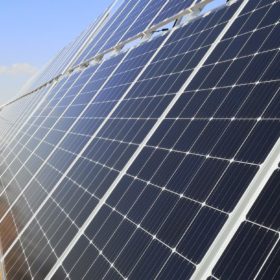
As it moves towards grid connection this month, the solar project in the south of Oman demonstrates the value proposition of n-type PV cell technology, Chinese solar manufacturer Jolywood has argued at the World Future Energy Summit. The project is said to be the largest n-type bifacial array in the world.

Innovation shines at pv magazine awards ceremony in Abu Dhabi
The winners of the 2019 pv magazine awards have been recognized in a ceremony alongside the World Future Energy Summit. The victors spoke of the importance of innovation being recognized within the industry.

Power Ledger to integrate blockchain-enabled energy auditing into PV assets
The Australian peer-to-peer energy-trading pioneer has purchased a 250 kW solar system that will use its new energy data management and settlement system to provide greater visibility on renewable energy sold to consumers under power purchase agreements.

Stretching exercises for crystalline silicon solar cells
Researchers from Saudi Arabia’s King Abdullah University of Science and Technology have created flexible solar cells made of crystalline silicon. They claim to have stretched a crystalline silicon cell’s surface by around 95% while maintaining conversion efficiency of around 19%.

Western Australia to fund renewable hydrogen feasibility studies
The government of the state of Western Australia has allocated funding from its Renewable Hydrogen Fund toward seven feasibility studies that could pave the way for significant renewable hydrogen projects around the state.

New organic redox flow battery aims for €0.05/kWh/cycle by 2030
An international research group led by CIC EnergiGUNE, a Spanish research center, is designing new redox organic flow batteries. The researchers claim the batteries will offer longer duration, as well as higher power and energy densities, in a more environmentally sustainable format. The European Commission provided €3.8 million in funding for the initiative.

Putting the strain into engineering a more stable perovskite
U.S. researchers claim to have improved the stability of one of the most promising halide perovskites – α-FAPbI3 – by squeezing the compound’s crystal lattices. The authors of the research prevented the crystal assuming an hexagonal shape at the room temperatures required for a PV device to operate properly.

Solar cells from space are on the way
A team at the U.S. National Renewable Energy Laboratory has come up with a new process that would reduce the production cost of highly expensive – and highly efficient – gallium arsenide cells.
Japanese manufacturer acquires rights to produce 23.26% efficient CIGS perovskite cell developed by HZB and Kaunas University
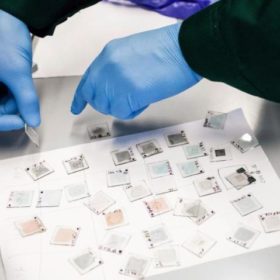
The research group that developed the cell said the two materials used to produce it, dubbed 2PACz and MeO-2PACz, will soon be commercially available. The material consists of 1-2nm of self-assembled monolayers deposited on the surface of the perovskite by dipping it into a diluted solution.
