
Exciting excitons
A research team from Columbia University has designed organic molecules that can produce excitons with a longer lifecycle than inorganic equivalents. The excitons have the potential to amplify the amount of electricity generated by the photons a solar cell absorbs.

Nanowire mesh offers better cell performance and lower costs
A new method of creating an ordered mesh of nanowires, developed by scientists at the Lawrence Livermore National Laboratory in the United States, could lead to the creation of more efficient transparent electrode layers in solar cells – and the elimination of a rare material from the manufacturing process.

A new spectroscopic method to understand the physical principles of organic PV
A German research team claims to have created a new visualization technique it says can enable detailed mapping of the energetic landscapes of organic PV cells on a nano scale. The technique could lead to organic cells with reduced power losses.
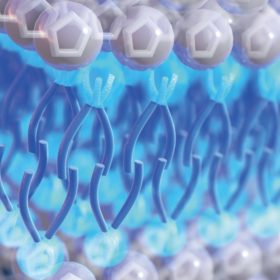
‘New and strange properties’ provide a boost to energy storage
MIT scientists have developed a class of liquid electrolyte with properties they say could open up new possibilities for improving the performance and stability of lithium batteries and supercapacitors.
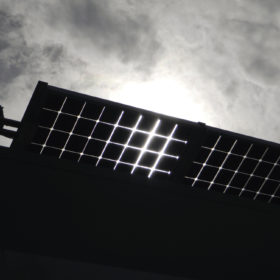
Webinar Q&A: Simulating the gains of bifacial and tracking installations, where’s the rub?
Following up on the webinar held with Trina Solar about the new algorithms needed for bifacial and tracking installations, the word is that gains of 20-30% are not unlikely. To attain that, however, the sweet spot of front and rear side yield has to be reached. Trina has showcased a new algorithm alongside its bifacial n-type modules and claims it can do just that.
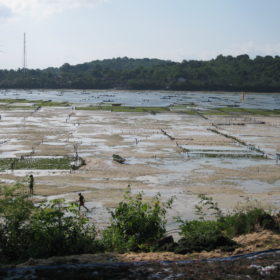
Aquavoltaics in the Philippines
An EU funded solar-plus-storage project has been tendered in the Philippines. The United Nations is seeking bids for the system, to support the seaweed industry on the island of Tawi-Tawi. Combining PV with aquaculture brings many advantages for both, including water conservation, a more controlled aquatic environment, and ecosystem restoration.
Stitching together the grid of the future
A vision of a decentralized, renewable-powered electricity grid is being brought a step closer by scientists at the U.S. National Renewable Energy Laboratory. Their project, Autonomous Energy Grids, aims to take an overarching look at the solutions that will power this grid of the future, and to fill any gaps that appear between them.

GCL-Poly posts $141m loss in H1
The Chinese PV group recorded a loss attributable to owners of the company of roughly $141.1 million, as its solar materials division posted a loss of approximately $185.5 million.
Using machine learning and cheap satellite data to design rooftop solar power
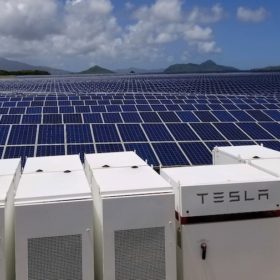
Researchers have built a tool to use cheap satellite imagery – like Google Maps – to automatically create solar designs with a 91% accuracy rate.
A close look at nature could lead to cheaper hydrogen
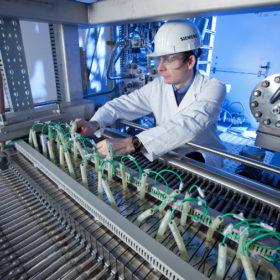
Scientists at the Australia National University have observed a key stage in the process of photosynthesis which could be copied to greatly increase the efficiency of sunlight-powered water splitting processes used to produce hydrogen.
