
German scientists develop new process for stable perovskites
A team of researchers from Germany’s Martin Luther University Halle Wittenberg has developed a new approach to perovskite cell production, which they say could result in better stability and longer lifetimes. The team also made detailed observation of the perovskite’s formation and decay, which could help to inform further research into high performance solar cells.

Singapore launches blockchain-based renewable energy marketplace
Companies keen to offset their carbon emissions will be able to purchase renewable energy certificates at Singapore’s first blockchain-powered marketplace, launched by electricity provider SP Group.
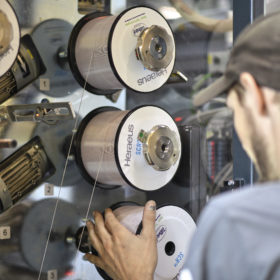
The weekend read: Coating puts busbars back in the game
In late September, Heraeus launched its Selectively Coated Ribbons (SCR) technology. The product will be rolled out in partnership with ribbon supplier Ulbrich. Delivering a 1.9 W power output boost without any equipment investment and with few process changes, Heraeus’ Toralf Eggert and Ulbrich’s Peter Berghofer claim SCR will make conventional busbars competitive with unwieldy multi-busbars.
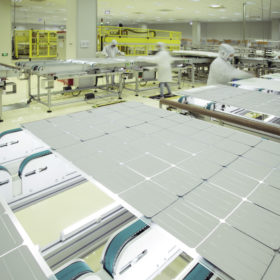
Longi sets new PERC module efficiency record
Chinese monocrystalline manufacturer Longi Solar Technology has broken its own record for PERC module efficiency, reaching 20.83% in independent testing conducted by TÜV Süd.
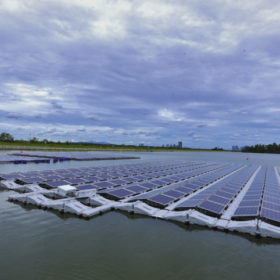
The weekend read: Staying afloat, whatever the weather
From a little known niche just a few years ago, floating solar has quickly grown to more than 1 GW of installed capacity worldwide, and a source of great hope for the industry’s future, particularly in countries where space for solar is at a premium. pv magazine spoke with experts from leading floating PV test centers in Singapore and the Netherlands to outline the challenges still faced by floating PV as the technology moves towards major growth.

Hyundai to launch solar body kits for vehicles
In a joint effort with Kia Motors, Hyundai Motors is developing solar roofs and bodies for its EVs, hybrids and ICE vehicles to provide additional charging capacity. Depending on solar irradiation levels, the technology could provide 30-60% battery charge per day, the manufacturer says.

Electricity and hydrogen, from one cell
Scientists at the United States Department of Energy’s Lawrence Berkeley Laboratory have created a hybrid device which can produce both hydrogen via water splitting and electricity via photovoltaics.
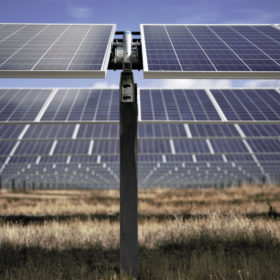
The weekend read: On track for broader horizons
The global vertical integration of the PV tracker industry is accelerating, as players seek to build organizations that can provide manufacturing and support in multiple markets simultaneously. These partnerships tend to connect intellectual property assets with global manufacturing capability and construction and engineering teams that have the financial wherewithal to pursue international markets. The trend also is driving product line expansion, as in the case of Nextracker’s offering of energy storage as an integrated part of its tracker design.
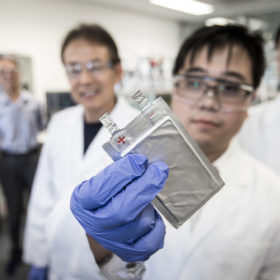
Australia: Sodium-ion batteries get commercial rollout as li-ion alternative
Sydney Water’s Bondi sewage pumping station will soon be storing solar energy through the use of 30 kWh of sodium-ion batteries, a cheaper alternative to the traditional lithium-ion batteries.

Bill Gates to establish €100 million clean energy fund with EU
If plans are realized, the private-public investment vehicle will start investing in companies with green-tech innovations. The fund would be used to pursue technologies which could help the decarbonization of the economy but which have not received enough attention.
