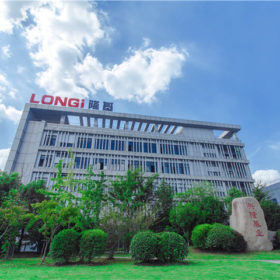
Longi achieves record conversion rate of 20.41% for PERC modules
Longi Green Energy Technology has announced a new record conversion rate of 20.41% for its P-type PERC monocrystalline modules (type 60).
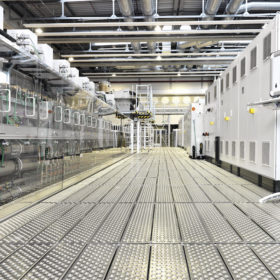
Leading research institutes to collaborate on flexible CIGS
Two of Europe’s leading research institutes, Germany’s Centre for Solar Energy and Hydrogen Research Baden Württemberg (ZSW) and the Institut Photovoltaïque D’Île de France (IPVF) have announced plans to closely cooperate in researching concepts for flexible solar cells utilizing CIGS technology.

Chinese researchers develop new gas-solid perovskite process
In another attempt at cracking the perovskite stability problem, scientists from China’s Liaocheng University and Hefei University of Technology have developed a new gas-solid process for the creation of perovskite thin films, which they say can lead to improved stability and response time.

Skanska, Saule Technologies to install BIPV perovskite modules on office buildings
The two companies have signed a license agreement. The first pilot projects with the semitransparent perovskite solar cells are planned for this year in Poland
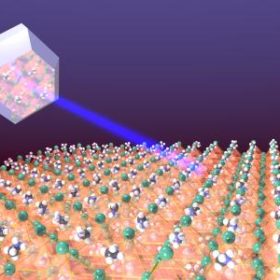
Harvesting energy from ‘hot’ electrons could boost perovskite efficiency
Scientists from the University of Groningen have discovered a tin-based perovskite material in which electrons retain high energy levels for much longer than previously. This discovery could allow for the creation of very high efficiency perovskite cells, by eliminating a large portion of energy loss through heat.
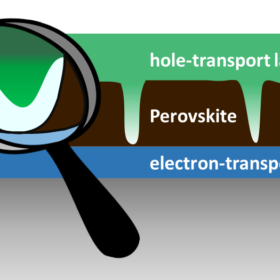
German scientists claim inhomogeneous perovskite films are highly functional
Contrary to common belief, holes in perovskite films may not always negatively affect the performance of perovskite-based solar cells, according to recent research from the Helmholtz Zentrum Berlin (HZB).
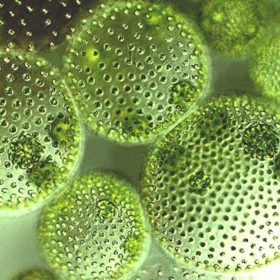
Researchers at Cambridge University develop new type of two-cell bio-photovoltaics
Researchers have developed and designed a new algae-powered fuel cell that is five times more efficient than existing plant and algal models, as well as having the potential of being more cost-effective to produce and more practical to use.
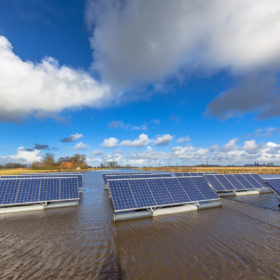
Netherlands: Newly created consortium to develop floating PV
The consortium, which has received funding from the Netherlands Enterprise Agency (RVO), is formed by Waterschap Rivierland, Blue 21 BV, Hakkers BV and TU Delft.

US scientists use additives to improve performance of organic solar cells
The research shows that films used in organic cells, which are produced more slowly with additives, generally perform better than the more rapidly formed films.
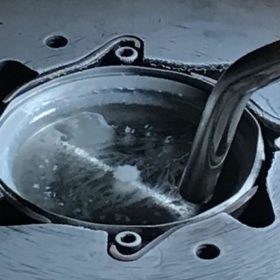
Scientists develop laser evaporation process for thin film deposition
A group of researchers from Duke University in the U.S. has developed a new coating process for the creation of hybrid thin film materials. The researchers say their process allows for the creation of solar materials that have until now proven difficult or even impossible to make.
