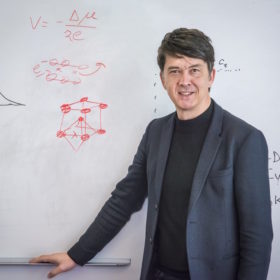
Berkeley scientists boost battery capacities
Scientists at the U.S. Department of Energy’s Lawrence Berkeley National Laboratory have made progress with cathodes made from ‘disordered’ materials, a technology which could greatly increase the storage capacity of lithium batteries.

Interview: keys to durability, and why it counts
From cost-per-watt on day one to output over 25 – 30 years: The understanding of value in the PV sector has begun to shift. Dow Chemical’s Brian Habersberger spoke to pv magazine about the materials helping inform and drive the transition.
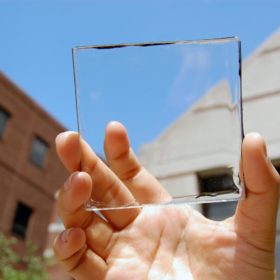
New transparent solar glass developed by scientists at Michigan State University
The new solar see through hardware was developed by engineers at Michigan State University, and is seen as a potential energy source which could collect to as much solar power as current traditional rooftop modules.
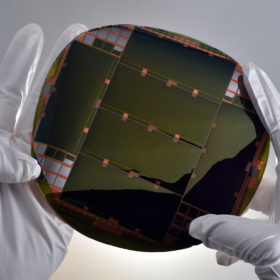
Microlink Devices signs deal with NREL to produce lightweight HJT cells
U.S. based semiconductor manufacturer Microlink Devices has signed an exclusive deal with the U.S. National Renewable Energy Laboratory (NREL) to commercialize a type of lightweight heterojunction solar cell architecture, which could be utilized in powering satellites and aircraft.
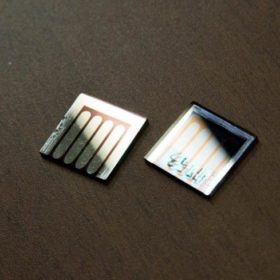
Korean scientists increase stability for perovskite cell
A joint group of researchers from South Korea’s Ulsan National Institute of Science and Technology (UNIST) and the Korean Institute of Energy Research has developed a method for increasing the stability of perovskite solar cells using low cost fluorine.
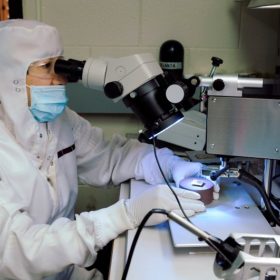
A*Star researchers develop technique for cheaper solar cell production
A*Star researchers, in a bid to find an alternative to silicon-based solar cells, are investigating a new material that is more cost-effective and easier to produce that could also lead to more efficient solar cells.

LONGi claims 22.71% PERC efficiency world record
Germany’s Fraunhofer ISE CalLab has confirmed that China’s Longi Green Energy Technology has achieved a record 22.71% conversion efficiency with its monocrystalline passivated emitter rear contact (PERC) solar cells.
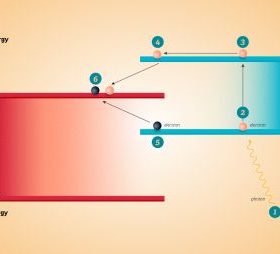
Technology with electron multiplication potential comes out of Lab at University of California
A new photodetector, a device that senses light, has been developed by Physicists at the University of California. The device functions by combining two distinct inorganic materials and producing quantum mechanical processes that could revolutionize the way solar energy is collected.
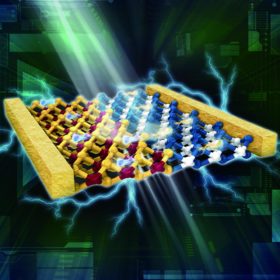
KAUST researchers look into lateral heterojunction
A team from King Abdullah University of Science and Technology (KAUST) in Saudi Arabia has published research into heterojunction solar cells using alternative materials to silicon. The researchers hope that the process they developed could simplify the fabrication of solar cells.

Italian researchers use graphene oxide to increase efficiency of perovskite cells
Scientists of the University of Florence claim that graphene-based electron transport layers (ETL) achieve higher carrier injection with respect to most commonly used ETLs.
