
Let it burn
Battery fires, while a rare occurrence given the number of lithium-ion batteries manufactured and deployed each year, are common enough to worry insurers and others in the industry. Following high-profile battery fires in 2024 and 2025, the industry is busy implementing solutions not only to reduce the risk of fire breaking out in the first place, but to contain and mitigate the risk of injury or damage should it happen. Conclusions from large-scale fire testing will be key.
pv magazine Awards: Modules
PV module technology stands at a crossroads in 2025, as reflected in highlights from the pv magazine Awards entries received so far. Tunnel oxide passivated contact (TOPCon) cells have rapidly taken over the mainstream, but manufacturers are already lining up their next move to higher performance, with back-contact and heterojunction products coming to the market in increasing numbers.
At the same time, the crowded marketplace has suppliers searching for niches to fill, and modules designed for specific applications, such as repowering or vertical installations, are becoming more common. Award winners will be chosen by a panel of expert jurors and announced in December 2025. Until then, we’ll be highlighting some of the top entries received across all seven categories. This month, it’s modules that take their turn in the spotlight.

Non-stop solar innovation
It’s no secret that prices throughout the solar supply chain have been at rock bottom over the past 18 months. Alex Barrows and Molly Morgan of CRU Group explore how the market reached the imbalance that caused PV prices to crash, what this has meant for innovation, and how it might affect future technology transitions.

Pain in the glass
Solar modules are getting bigger, thinner, and more powerful. But from Texas to Thailand, the same problem is appearing: broken glass. These breakages are not caused by hail, dropped tools or obvious mishandling. Instead, cracks spider out from frame edges, splinter near clamps and web across modules. In cases seen by Jörg Althaus, director of engineering and quality assurance services at Clean Energy Associates (CEA), it starts with a few panels – then dozens, hundreds, even thousands.
pv magazine test: April 2025 results
George Touloupas, vice president of ESG and new services at Clean Energy Associates (CEA), and Huatian Xu, CEA’s director of technology and quality, analyze the April 2025 results from the pv magazine test outdoor installation in Yinchuan, China.

Recovery discovery
Can you give some background on recent industry concerns around ultraviolet-induced degradation in PV modules? For around two and a half years, we have been involved in several projects where larger module buyers benchmark different module types against each other in terms of reliability. In this context, we realized that there was strong UV degradation […]

Immersed in thermal management
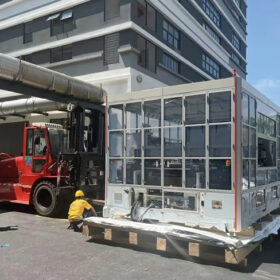
Effective thermal management is essential for the safety and performance of battery energy storage systems (BESS). Thermal runaway events can have catastrophic consequences and poor heat dissipation hurts BESS performance in the long run. While air- and liquid-cooling are the industry standard for tackling high temperatures, immersion has emerged as a novel approach.
Green economy dominance
Both the solar module and battery manufacturing industries have been dealing with excess production capacity in recent years, and each is undergoing its own set of market adjustments in 2025. This has meant challenging conditions for manufacturing equipment suppliers in either sector. But there is still plenty of opportunity to deploy the latest technologies at scale, and to assist suppliers moving into new regions. The long-term outlook for both sectors is strong, as pv magazine heard from Wang Yanqing, Chairman of solar and battery production equipment supplier Lead Intelligent, headquartered in Wuxi, China.

Surviving the squeeze
As US-China tariffs escalate, China’s solar industry finds itself at the center of a geopolitical storm that threatens not only its global market share, but also the world’s decarbonization goals. Vincent Shaw reports from Shanghai.

Scaling up in Saudi Arabia
Saudi Arabia made a raft of renewables commitments as part of its Vision 2030 plan, announced in 2016. Nearly a decade on, the country is developing local supply chains for renewables and energy storage components while deploying solar and storage projects at scale. Energy storage expert Marek Kubik discusses Saudi Arabia’s project and manufacturing progress.
