
EDP: ‘PV will be one of the most dominant sources of power generation’
Portuguese electricity and gas company EDP used the 2019 Web Summit event as an opportunity to undermine the role of fossil fuels.

Chile to hold new energy auction in June
According to the bidding terms published by the National Energy Commission, project proposals may be submitted by June 11 and the results will be announced on June 19. Successful bidders will secure a 15-year power supply deal and some 5.6 TWh of electricity is expected to be generated annually as a result of the new capacity.

Bangladesh sets solar import standards
Complaints about sub-standard, cheap PV imports from China – and notably, India – have been heeded by Dhaka, which has issued a requirement for modules, inverters, charge controllers and batteries to attain IEC electrical standards.
More claims of greenwashing at major US electric utilities
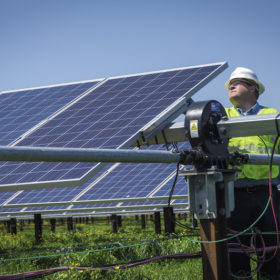
A survey reveals greenwashing among major U.S. investor-owned electric utilities, which have been accused of using disproportionately high ratios of renewable versus fossil fuel images and language, while at the same time helping to block renewable energy policies. pv magazine speaks to the lead researcher
A record year for trackers
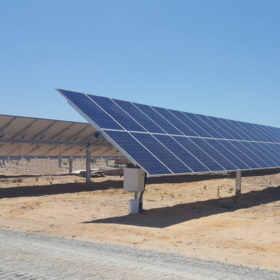
It was a record year for global shipments of single-axis solar photovoltaic (PV) trackers in 2018, as they increased by more than 40%, surpassing 20 GW globally for the first time, writes IHS Markit senior analyst Camron Barati. While the United States continued to be the largest individual market for single-axis trackers last year, shipments also increased in Mexico, Australia, Egypt, Spain, and other large utility-scale markets.

A whole new KIT of solar cell materials
Scientists at Germany’s Karlsruhe Institute of Technology have received €4.5 million from the Carl Zeiss Foundation to begin a project developing an entirely new solar cell concept they say will combine the printability of organic PV, long-term stability of crystalline solar cells and ferroelectricity of lead-halide perovskites.
Solar will power ahead to offer 20% more output for 25% lower module costs within 15 months
PV industry veteran Karl-Heinz Remmers recalls the trajectory of solar power this decade and predicts stronger than expected development for the ten years ahead.

Hot news on harvesting electrons in perovskites
An international research group claims to have developed a new bulk perovskite semiconductor material that can capture the excess energy of hot electrons. The material is said to rapidly absorb as heat energy which would otherwise be wasted. With the harvesting of hot electrons, the maximum theoretical efficiency for hybrid-perovskite solar cells could increase from 33% to 66%.

PV takes a stand at 2019 Web Summit
This year’s record-breaking event held in Lisbon, Portugal, included an energy track devoted to renewable sources and technology to address climate change.
European Utility Week: ‘The confidence is coming back’
The energy transition is becoming ever more apparent among power companies, as was evident at the European Utility Week event last week in Paris, which showcased the hopes and fears of energy companies. Rebranding next year to ‘Enlit’, the organizers aim to reach the whole energy industry.
