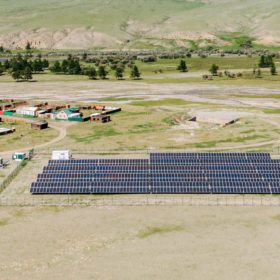
LCOE of off-grid solar-plus-storage in Russia’s remote areas ranges between $0.19 and $0.29/kWh
Off-grid PV has become a much more viable solution than diesel power generators to bring electricity to Russia’s remotest regions. Furthermore, solar-plus-storage is able to deliver with no interruption 24 hours per day and seven days per week, while fuel availability means diesel power can only ensure between four and seven hours per day.

Hungary’s second renewables auction concludes with lowest bid of $0.0549/kWh
The auction has been significantly oversubscribed and has seen 36 successful projects among 257 submitted. Around 390 GWh of power was contracted and will be provided exclusively by PV projects.
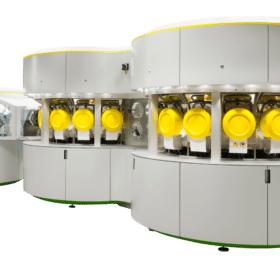
Midsummer ships CIGS production line to Russia
The production equipment was bought by Russian nanotechnology specialist Rusnano. The line will be used to produce BIPV modules at a factory in the Republic of Mordovia.

Photon closes €13m refinancing for Hungarian solar projects
Ten arrays commissioned in the last four months, with a total generation capacity of 14 MWp, have been refinanced with a 15-year loan.

Russia to tender 500 MW of solar in 2021
The country’s cumulative installed PV capacity reached 1.7 GW at the end of 2019, as a result of the grid-connected projects tendered by the Russian government between 2014 and 2019. The remaining 500 MW quota of the 2.2 GW tendering scheme should be assigned this year.
Romania improves rebate scheme to speed up rooftop PV development
The Romanian government has changed the rules of the Casa Verde Fotovoltaice (green PV home) scheme to support residential solar installations under the country’s net metering regime. The new provisions improve the installation process and settlement of rebate payments.
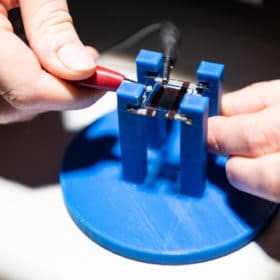
Inverted perovskite solar cell with transition metal carbides achieves 19.2% efficiency
A Russian-Italian research group has developed a two-dimensional transition metal carbide, known as MXenes, to collect photocurrent in perovskite cells. The cells were built with an inverted configuration and are based on a nickel(II) oxide hole transporting layer. The scientists claim that the doping technique allowed them to increase the efficiency of the cell by more than 2%.
EIB finance for Burkina Faso solar plant
The European Investment Bank will lend more than half the cost of expanding the first solar project built by the West African nation’s electric utility, from 37 MW to 50 MW.
Poland’s first solar PPA will see photovoltaics power cement production
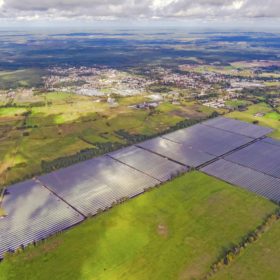
The local subsidiary of German company Heidelbergcement will take solar electricity from the 65 MWp Witnica solar park between Poznań and Berlin for ten years under the power purchase agreement.
European Commission approves further €2.9bn battery research project
Companies from a dozen EU member states will commit the public funds in a bid to come up with novel battery chemistries and production methods as well as recycling and circular economy innovation.
