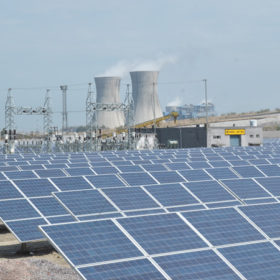
India to replace thermal power with renewables under existing PPAs
Indian generators and distribution companies will evenly split the gains achieved by bundling cheaper renewable energy with high-cost thermal sources.

Indian government expands budget for PV manufacturing scheme
The Indian authorities have announced plans to provide more funding to help more manufacturers under its production-linked incentives scheme, which is designed to support gigawatt-scale manufacturing of high-efficiency solar modules.

Indian transformer manufacturer to set up 4 GW solar fab
Shirdi Sai Electricals, an Indian transformer manufacturer and EPC contractor, has placed a $252.16 million incentive bid to set up a fully integrated, 4 GW polysilicon-to-module fab under the Indian government’s production-linked incentives scheme.

Adani Green targets 45 GW of renewables capacity by 2030
Indian renewable energy developer Adani Green had an operational capacity of 5.4 GW – including 4.76 GW of solar and 647 MW of wind – as of Sept. 30.

Analyst revises up zero-emission vehicle forecast after bumper year
A report published by BloombergNEF for the COP26 climate change summit has listed global commitments by cities, states, provinces and nations to end the sale of new fossil-fueled vehicles but, with 2035 estimated as the cut-off date for zero-emission roads by mid century, policymakers need to be more ambitious.
Where are we headed with off-grid PV?
An increasing number of people choose to design their PV system so it can be used even when the grid power has gone – as a back-up, so to speak. But there are markets where off-grid PV is not the back-up solution, but it is the primary source of power. There are numerous examples ranging from holiday homes and house boats in the south of Europe, to remote farmhouses, and rural regions in Africa and Asia where people don’t always have grid access. To this end, our webinar partner Solis has introduced its latest off-grid inverter which kicks into life at a mere 500 V input voltage.
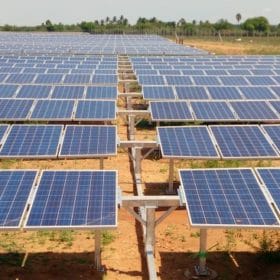
Indian government may offer extensions for PV projects due before April
The Ministry of New and Renewable Energy has asked the dispute resolution committee to look into commissioning extension requests for solar projects that are due for delivery before April 1, 2022.

End-of-life management of solar PV waste in India
A new study proposes an ‘extended producer responsibility’ regulatory framework for end-of-life solar PV management in India.
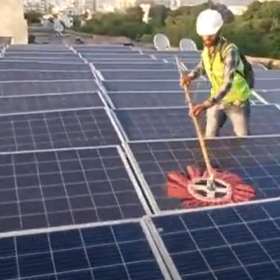
Handheld dry-cleaning tool for solar modules
The handheld, cordless cleaning tool is a cost-effective and efficient alternative to automated cleaning robots that are usually limited in operation by panel inclination.
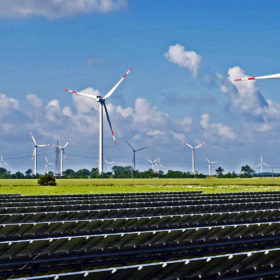
India tenders 1.2 GW of wind-solar hybrid projects
Developers have until Dec. 6 to bid to set up a cumulative 1.2 GW of wind-solar hybrid capacity on a build-own-operate basis, anywhere in India.
