Rajasthan solar auction draws electricity price of just 3.5 US cents
Record-setting Acme Solar has secured a third of the latest procurement exercise in the state with a lowest bid of INR2.48/kWh. The tender was oversubscribed by more than 100% as offers came in for 1,620 MW of capacity.
India goes into overdrive with 6 GW tender plans announced in five days
SECI, the organization responsible for coordinating India’s push for 100 GW of new solar capacity by 2022, has had a busy week. But, as last year illustrated, tenders alone are not always a guarantee of new generation assets.
Solar made up 50% of India’s new power capacity in 2018
The level of new solar capacity – 8,263 MW – however, was 15.5% down from the 9,782 MW added in 2017 owing to safeguarding duty and tax taking a toll on large-scale PV. While utility-scale solar declined 23% year-on-year, rooftop PV remained a bright spot, and registered impressive growth of 66%.
India hits Malaysian solar glass with anti-dumping duty
The Indian government has imposed anti-dumping duty of $114.58/metric ton on tempered solar glass imports originating in or exported from Malaysia. The five-year duty will be applied to products from producers except Xinyi Solar.

India slaps anti-dumping duty on east Asian EVA sheets
Following a petition by domestic PV panel manufacturers, India’s Directorate General of Trade Remedies has recommended the imposition of duties ranging from $537-1,559/metric ton on solar ethylene vinyl acetate sheets imported from China, Malaysia, Saudi Arabia and Thailand.
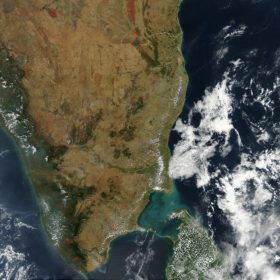
The promise of a 100% renewable energy world
The oldest solar organization in the world, the International Solar Energy Society, dates back to 1954. President David Renné tells pv magazine about India’s solar dreams, the next best thing in solar technology and what renewables hold for the world’s future.
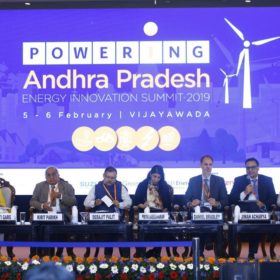
Developing an energy sector vision in Andhra Pradesh – IEEFA India
Situated in south-east India, the state of Andhra Pradesh is a leading producer of renewable energy with 7.2 GW of installed capacity as of December 2018. The state’s share of renewable energy as part of total capacity has trebled in the last four years from 11% in 2014 to 30% in 2018.
Indian government approves $6.48bn for rooftop and farmland solar
As national elections approach, prime minister Narendra Modi has signed off a huge check to finance national programs to subsidize household and community PV and to drive solar pump deployment in the nation’s fields.

Tender for 20 MW of floating solar-plus-60 MWh storage in Indian archipelago
The Solar Energy Corporation of India has invited bids for the development of an aggregate capacity of 20 MW of lagoon-based floating PV with 60 MWh of battery-based storage systems in the union territory of Lakshadweep.
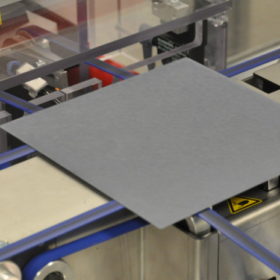
Rise in Chinese mono PERC cell output helps stabilize multi cell price as Indian orders slow
The big manufacturers turned their Chinese new year production efforts to higher efficiency products but order volumes for standard cells fell during India’s peak PV season, according to PV Info Link.
