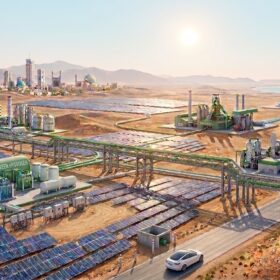
Solar-to-X could redefine Iran’s energy future
Iran is widely known for its oil and gas resources, but its strongest long-term energy asset may be the sun. New research shows how solar PV could drive a cost-competitive transition across power, heat, transport, industry, and desalination, while opening the door to a broader Solar-to-X Economy.

Reducing PV module temperature with twisted tape
Researchers in Iran have investigated how twisted tape in water-cooled channels can enhance heat transfer in solar modules. They have used a computer simulation to analyze the new approach with different parameters and have found the panels’ ectrical efficiency increased by up to 11.84%.
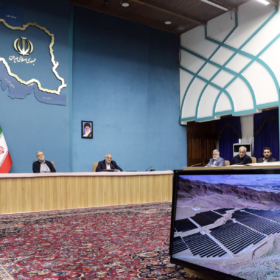
Iran inaugurates 250 MW of new solar plants
Speaking at an inauguration ceremony that also marked the start of a further 450 MW of solar plants, Iran’s President said the government is prepared to remove any obstacles facing the acceleration of new solar projects.
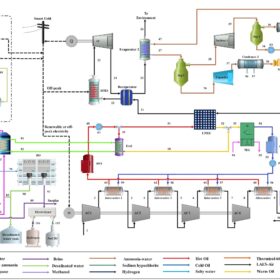
PV-powered liquid air system yields hydrogen, heating, fresh water
A global scientific team has designed a novel multigeneration system based on renewable energy and liquid air energy storage, then used soft computing techniques to optimize its operation. The optimized levelized costs of hydrogen (LCoH) were $1.52/kg and $5.22/m³.
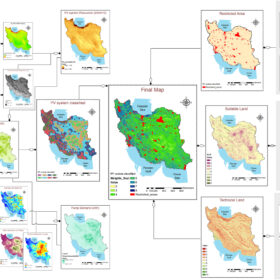
Map shows 43% of Iran’s land unsuitable for PV-powered water pumps
Scientists used geographic information systems and analytical hierarchy process methods to identify Iran’s most suitable areas for PV water pumping systems. They found 43.2% of land unsuitable, with Ardabil province the most favorable.
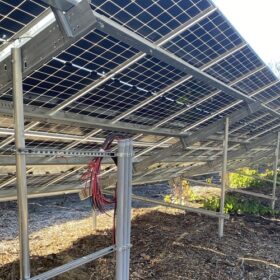
Parameter analysis of 842 bifacial solar modules from 236 manufacturers
An international research team has conducted an extensive overview of bifacial solar modules from 39 countries. Their analysis took into account the best of the median values indicated in the product specifications and found that heterojunction and back-contact panels provide the best parameters.
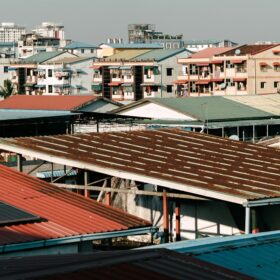
Behavioral factors behind residential PV adoption in China
Researchers have combined the theory of planned behavior, the technology acceptance model, and diffusion of innovations theory to investigate rooftop solar adoption in China. From a 1,200-person survey, they found that subjective norms and social influence from peers and community had a surprisingly more substantial effect than personal attitudes or perceived ease of use.
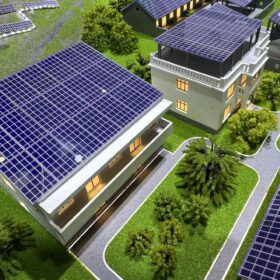
Novel sizing approach for PV, battery storage in smart homes
Scientists in Iran have developed a novel framework to optimize the capacity of PV and battery storage in smart homes, using a two-stage stochastic programming model. They considered the uncertainties in the grid, market price, and PV output, while also looking at different operation cases.

Cooling PV modules with porous silicon-carbide ceramic, PCM
Researchers in Iran developed a passive solar module cooling method using silicon carbide porous ceramic. When combined with phase change materials, the technique reportedly boosts panel performance by up to 7.4%.

Scientists testing perovskite-silicon tandem solar cells with interdigitated back contacts
A research team in Iran has designed a four-terminal perovskite-silicon tandem solar cells with a 19.3%-efficient bottom heterojunction cell and a 12.7%-efficient perovskite top cell. Both subcells were conceived to have interdigitated back contacts, with the top cell reportedly helping to improve the tandem device’s light-trapping and efficiency.
