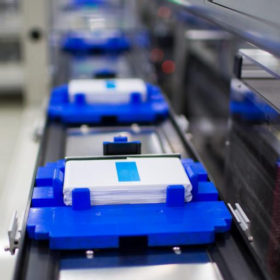
‘China must put EV battery reuse at heart of net-zero ambition’
The centralized nature of policymaking in Beijing would enable component standardization to ease the transition from EV to stationary energy storage use, according to Greenpeace East Asia.

South Korea follows Japan with net-zero 2050 pledge
Re-elected South Korean president Moon Jae-in today declared he will follow-up on a campaign trail promise to eliminate carbon emissions by mid century. The announcement comes just two days after Japan’s new prime minister said he would accelerate his nation’s emissions target.
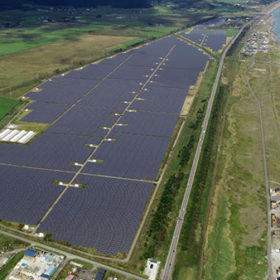
Japan’s largest solar-plus-storage plant is now operational
Softbank has energized a 102.3 MW solar park backed by 27 MWh of lithium ion storage capacity. The project was built on 132 hectares of land near the town of Yakumo, in the northern island of Hokkaido.

Improving outdoor I-V curve measurements with PV module irradiance sensors
Japanese scientists have replaced common pyranometers with PV module irradiance sensors to measure the I-V curves of crystalline silicon PV modules. The sensors provide highly precise outdoor measurements, the researchers said.
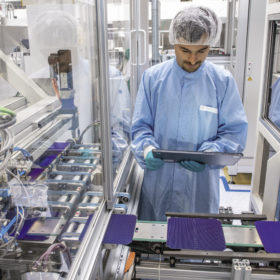
IRENA presents $2tn plan to drive 5.5m renewables jobs by 2023
Doubling down on renewable energy investment and energy transition spending is required to ensure a truly green global recovery from the Covid-19 crisis and its economic aftershock, claims the International Renewable Energy Agency.

Maxeon Solar sues Canadian Solar for alleged patent infringement on shingled technology in Japan
The SunPower spinoff claims that Canadian Solar has infringed its Japan Patent No. JP6642841B2 for shingled solar modules.
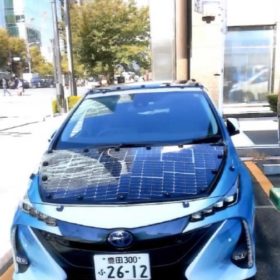
III-V solar cells for PV-powered EV applications
According to a new study from Japan, the global installed PV capacity in solar-powered EVs may reach up to 50 GW by 2030. Its authors claim that solar cells with efficiencies higher than 30%, including multijunction III-V cells and III-V cells combined with silicon cells, are the best candidates for applications in the automotive sector due to the limited space of electric car rooftops. However, a series of technical and economic challenges must still be addressed.
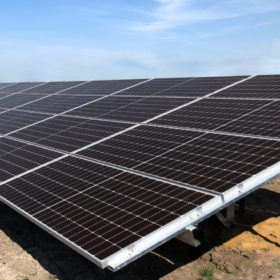
Sharp unveils 440 W half-cut PV module with 19.9% efficiency
The Japanese manufacturer said the new solar panel features 144 half-cells based on M6 wafers and a nine-busbar design, with a positive power tolerance of up to 5%.

Toshiba develops more Japanese solar and hydrogen
The electronics giant is building two PV plants with a combined generation capacity of 58 MW owned by U.S. module manufacturer First Solar. Toshiba is also extending its hydrogen research project in Fukushima for another two years.
National lithium-ion battery supply chains ranked
Analysts at Bloomberg New Energy Finance have quantified the influence of markets around the world. The ranking supplies a snapshot of 25 countries and also offers a five-year outlook.
