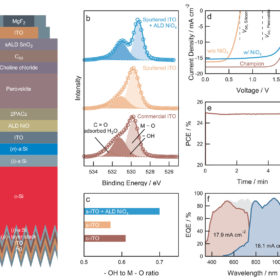
Monolithic perovskite-silicon tandem solar cells for water splitting
Researchers in the Netherlands have designed a water-splitting system with an electrochemical cell and a 25%-efficient tandem perovskite-silicon solar cell. It can reportedly achieve a solar-to-hydrogen efficiency rating of more than 21%.
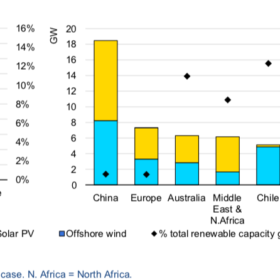
The Hydrogen Stream: Global renewables capacity for hydrogen to surge by 2027, says IEA
The International Energy Agency says that it expects the use of renewables to support global hydrogen production to surge over the next five years. The Netherlands and Denmark, meanwhile, have revealed plans to expand electrolysis capacity.
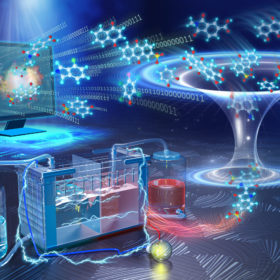
Scientists identify molecules for potential use in redox flow batteries
Scientists at the Dutch Institute for Fundamental Energy Research (DIFFER) have set up a database of 31,618 molecules that could potentially be used in future redox flow batteries. They used artificial intelligence and supercomputers to identify the properties of the molecules.
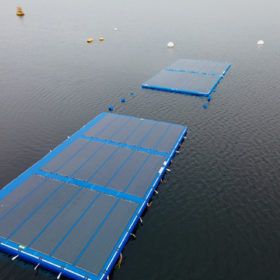
Dutch developer secures funds for flexible floating solar pilot in North Sea
Bluewater Energy Services has won a grant from the Dutch government to build a flexible floating solar demonstration project in the North Sea. The system uses flexible thin-film PV modules and flexible floaters that move with the waves.
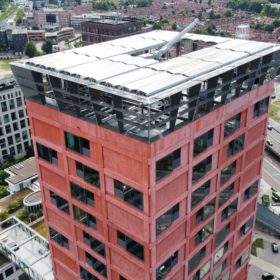
Rooftop system with PV panels, mini wind turbines in the Netherlands
Ibis Power has developed a rooftop system that combines solar with wind turbines designed for medium-sized structures and high-rise buildings. It claims its PowerNEST system can produce six to 10 times more energy than standalone rooftop solar. The company has already installed five projects in the Netherlands.
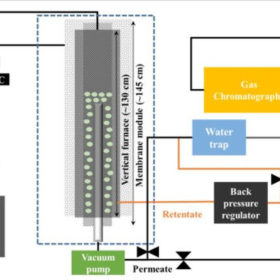
The Hydrogen Stream: Green hydrogen via ammonia decomposition
South Korean scientists have developed a highly selective palladium composite membrane on porous metal supports to cut the ammonia content of the permeated hydrogen stream. Dutch researchers, meanwhile, have presented two alternatives to this strategy – increasing the thickness of the membrane selective layer, or using a purification unit in the permeate of the membranes.
Netherlands changes grid code to reduce congestion, host more renewables
New rules in the Netherlands will allow new entities known as “congestion service providers” as intermediaries between grid operators and power plant operators, in order to make optimal use of the network.
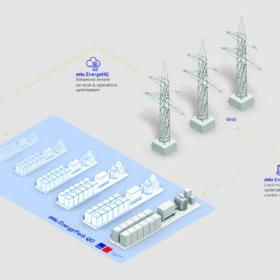
Rolls-Royce to supply largest battery in Netherlands
Rolls-Royce has agreed to install a 30 MW/60 MWh storage system based on nickel-manganese-cobalt (NMC) batteries in the Netherlands. It will be the country’s largest energy storage system upon completion in spring 2023. It will provide grid frequency regulation services to the Dutch grid.

Low-breakdown-voltage TOPCon IBC solar cells to improve shading tolerance
Scientists in the Netherlands have looked at how TOPCon IBC solar cells could help to reduce the impact of shading on solar modules.
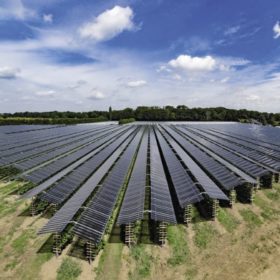
Netherlands selects 2.2 GW of PV projects in new SDE++ round
Solar has dominated the 2022 round of the SDE++ program for large-scale renewable energy projects in the Netherlands, accounting for around 90% of all pre-assigned capacity. About 2,269 MW of PV project proposals have been accepted.
