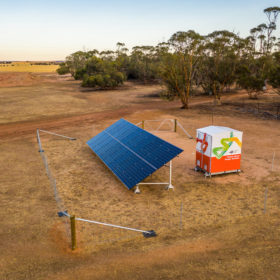
New factory for standalone solar+storage systems in Australia
Solar and microgrid specialist Hybrid Systems Australia has revealed plans to establish the “world’s biggest” standalone power system manufacturing facility in Western Australia.

Registrations of interest open for Australia’s 8 GW renewable energy zone
Australia’s largest renewable energy zone is one step closer to fruition with the New South Wales Government calling for registrations of interest from developers of solar PV, wind and energy storage projects.
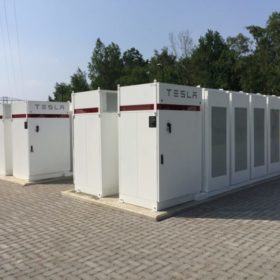
Australia can power renewable energy age, says Tesla
Tesla said it plans to heavily invest in raw materials from Australia for its batteries. The company said the nation now has the chance to secure a more lucrative slice of the global supply chain as the world transitions to renewable energy.

ARENA CEO floats ambitious new goals for Australia’s future electricity system
Darren Miller, the chief executive of the Australian Renewable Energy Agency, says he expects Australia to become a “shining example” of how a country can produce more clean electricity than it actually needs.
Batteries boom in Australia as renewable investments decline
The Clean Energy Council says investors are shying away from large renewable projects in Australia, as government intervention has created uncertainty and grid risks are tough to quantify – even with a prized connection agreement in hand.
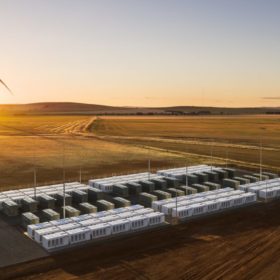
Australia’s energy storage installed base to grow more than five times by 2030
In its latest report, IHS Markit predicts that energy storage installations in Australia will grow from 500 MW to more than 12.8 GW by 2030. Today, Australia makes up less than 3% of total global installations for battery energy storage and is the seventh largest market globally. By 2030, it is forecast to comprise 7% of global installations and become the third largest market. This growth will be largely driven by three distinct market segments: residential, standalone front-of-the-meter, and collocated with utility-scale renewables.
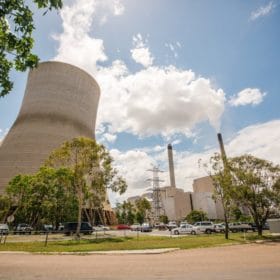
Australian power outage sparks calls for big batteries
Queensland’s worst power outage in decades has triggered calls for the introduction of more utility-scale batteries to provide security for the Australian state’s electricity network.
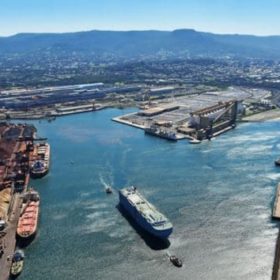
Getting Australia’s hydrogen economy right
Australia’s hydrogen hype is raising questions about how to design the “future fuel” sector so it doesn’t become a fossil fuel lifeline. Nicky Ison, WWF Australia’s energy transition manager, lists ways to ensure that Australia’s hydrogen economy is cleanly built.
Australian state bans door-to-door sales for solar companies
Victoria’s state government has introduced new rules for solar businesses and energy retailers banning door-to-door sales of products and announcing penalties of up to $1 million for retailers that wrongfully disconnect the electricity of vulnerable Victorians.
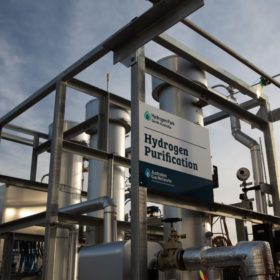
Australian study labels green hydrogen cost projections as ‘too conservative’
A new study commissioned by the Clean Energy Finance Corporation has indicated renewable hydrogen is already approaching cost competitiveness with that produced using fossil fuels but some in the industry say the government-owned green bank’s figures are much too conservative.
