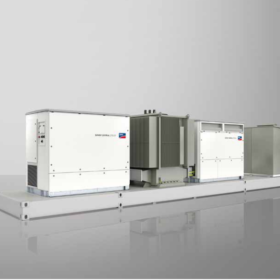
SMA to supply Australia’s biggest solar farm
The Western Downs solar farm will deploy German power electronics made in Australia, with SMA announcing that it has picked up a contract to supply the 400 MW (AC) project.
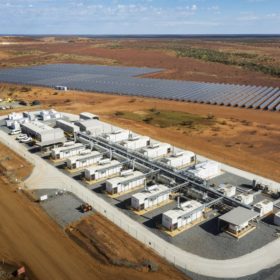
56 MW hybrid wind-solar plant powers up at Australian gold mine
The unique solar, wind, and battery project has been completed at Gold Fields’ Agnew Gold Mine, marking Australia’s largest hybrid microgrid of its kind.
New method for life cycle assessment of PV technologies
Researchers in Australia have conducted a ‘cradle to grave’ life cycle assessment (LCA) of the four most widely used PV technologies. The academics say that cadmium telluride solar modules have the lowest life cycle impact, followed by amorphous, multi and monocrystalline silicon products.

University of Queensland’s Tesla battery paying for itself
The University of Queensland has released a performance report on the Tesla Powerpack it installed in December 2019. Across a range of revenue streams, the Powerpack is already earning the university some serious cash.
Australia’s rooftop PV juggernaut displaces fossil fuel generators
The unstoppable growth of Australia’s rooftop PV fleet continues to eat into the pie previously reserved for coal and gas, a new audit of the National Electricity Market shows. Meanwhile, the nation’s electricity consumption has remained mostly flat despite the economic slowdown triggered by the Covid-19 pandemic.

Covid-19 weekly briefing: US residents ponder solar during lockdown, Aussie installers wonder what might have been and the Indian EV industry calls for help
Plus, Italian developers continue to dig deep for their health service, the pandemic piles on problems for a debt-saddled Chinese company and analysts consider whether there will be any money left for a green economic recovery after the dust settles.

Micronesia launches tender for utility scale solar-plus-storage
The government of the Federated States of Micronesia wants to increase power generation capacity on the islands of Yap and Kosrae.
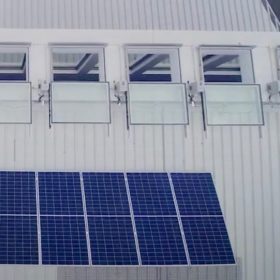
Solar chimney saves energy and lives
Researchers at Australia’s RMIT University have designed a solar chimney that could offer powerful safety and environmental benefits.
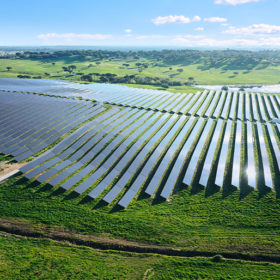
Neoen to build Australia’s largest PV plant in power deal with CleanCo
The Western Downs project will become Australia’s largest solar farm upon completion, roughly 460 to 480 MWp. The installation is expected to produce significant economic benefits in southwestern Queensland.
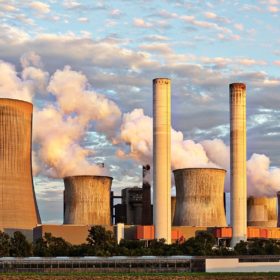
Covid-19 weekly briefing: Evidence abounds of renewable energy gains at the expense of fossil fuels as the clamor for a green recovery rises
Portugal set a new coal-free record because of the pandemic as Belgium and Israel moved to help the renewables industry. But there was grim news in Mexico and Turkey, and Bangladeshi clean energy firms have appealed for more assistance.
