Australian government stimulates PV in the face of Covid-19 threat
The federal government’s ‘economic response to the coronavirus’ legislation encompasses the installation of commercial and industrial solar.
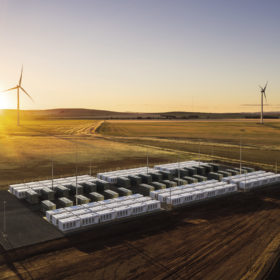
Capturing the full value of energy storage
The International Renewable Energy Agency has devised a valuation framework to lay the foundations for successful storage deployment. As the technology matures and moves toward a projected fall in price, revenue stacking will be crucial to assess viability and properly value its benefits.
Forget toilet paper, Australians are panic-buying PV
Byron Bay-based solar retailer Smart Energy says it is seeing an unprecedented surge in sales and enquiries for solar and home energy storage as consumers look to shore themselves up in uncertain times.

Amazon signs solar deals in Spain and Australia
Chinese PV heavyweight Canadian Solar has announced an offtake deal for its Gunnedah solar project with e-commerce giant Amazon in the Australian state of New South Wales. The e-commerce giant also plans to build a 50 MW solar plant near Zaragoza, in eastern Spain.

Stanwell’s utility-scale green hydrogen plans get financial shot in the arm
A feasibility study will explore a new option for producing and using renewable hydrogen, with the help of funding provided by the Australian Renewable Energy Agency (ARENA). If the study supports the business case, the project will deliver the largest hydrogen electrolysis plant in Australia.
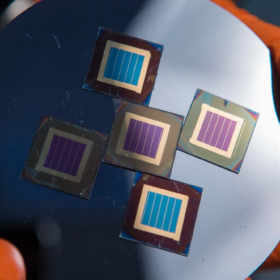
Australian researchers push boundaries on tandem solar cells
Scientists at Australian National University have achieved a 27.7% efficiency rate for mechanically stacked perovskite-silicon tandem cells.

Australian government redirects funding for Energy Transition Hub
The Australian federal government said last week that it will curtail funding for the five-year Energy Transition Hub research initiative.
AE Solar enters Australian market, introducing new module features
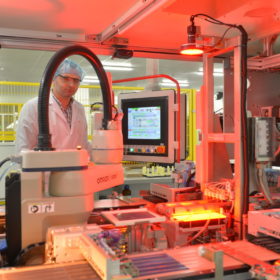
German-headquartered module manufacturer AE Solar is looking to enter the Australian market in 2020. It has begun accrediting its module range with the Clean Energy Council and believes its Supreme modules, which are resistant to shade and hot spots, will attract installers.
Bushfire-affected South Australia homeowners to get free sonnen batteries
The state government has partnered with the German energy storage company to offer 188 families locally assembled sonnenBatteries as they rebuild their homes.
Australia’s AEMC rejects new rule for calculating transmission losses
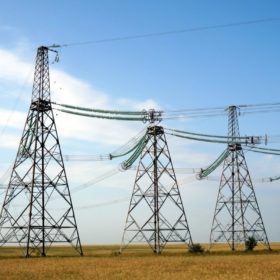
The Australian network regulator has ignored pleas from some of the biggest solar and wind project owners in Australia to change the way marginal loss factors (MLFs) are calculated. While it has acknowledged that transmission has failed to keep pace with renewable energy investment, it did not offer any suggestions on what should be done to ameliorate the problem.
