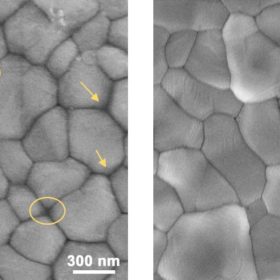
New ‘cushion’ solution to take stress off perovskite solar cells
Scientists in Germany have discovered a polymer compound that, when added to perovskite thin-film precursor materials, wraps itself around the perovskite crystals, acting as a cushion to protect the perovskite structure from thermomechanical stress. They used the additive to fabricate cells with up to 24.6% efficiency, retaining 96% of their initial performance after accelerated testing equivalent to one year in the field.
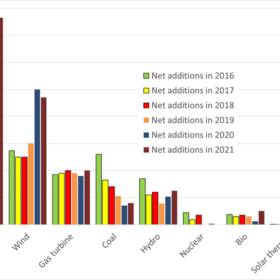
The fastest energy change in history
Solar and wind are being installed at a rate that is three times faster than all other new electricity sources combined. This offers compelling market-based evidence that PV and wind are now the most competitive and practical methods for deploying new generating capacity.

Ready for takeoff
Airport PV can provide an instant boost to emission-reduction efforts while work continues on sustainable aviation fuels. Developing solar projects at or near airports, however, is not as straightforward as typical ground-mount installations.
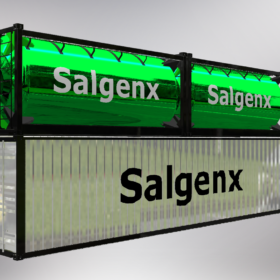
US startup unveils saltwater flow battery for large-scale storage
US-based Salgenx has developed a scalable redox flow battery with two separate tanks of electrolytes, one of which is saltwater. Unlike other flow batteries, the new device is membrane-free, promising big gains at the levelized cost of storage level.
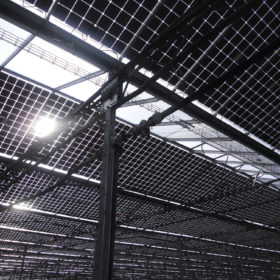
New method to measure energy yield of bifacial PV systems
Canadian scientists have developed a new way to measure the energy yield of bifacial PV systems. They said they considered the spectral albedo of ground cover like snow and sand to predict energy gains of up to 2%, in comparison with the International Electrotechnical Commission (IEC) standard.

Weekend Read: Giga and giga
pv magazine Australia’s Natalie Filatoff reports on the benefits of planning vast solar project pipelines, and the barriers faced by those who dare to dream big.
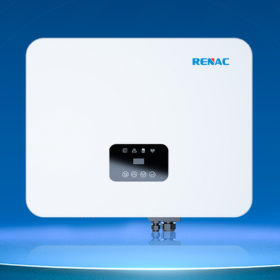
Renac unveils high-voltage hybrid inverters for residential applications
Renac Power’s new hybrid inverters have efficiency ratings of up to 97.5% and European efficiency ratings of 97.2%. They are available in four versions, with power outputs ranging from 3 kW to 6 kW.
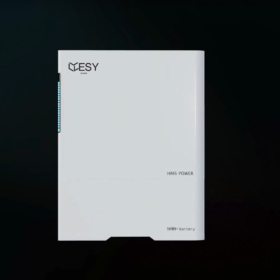
New residential battery inverter solution from China
Esysunhome (ESYSH), a new energy storage company in China, has developed a 5.12 kWh lithium iron phosphate (LFP) battery system with a 7.9 kW inverter. It says six modules can be combined for up to 30.72 kWh of energy storage capacity.
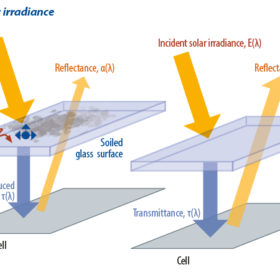
Rethinking soiling
The two dominant methods used in the industry to estimate soiling levels on solar projects go some way in mitigating losses, but there is plenty of scope for more accurate observation.
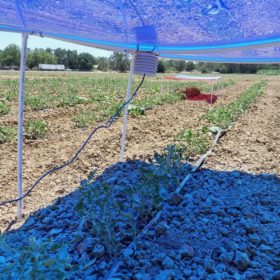
Agrivoltaics based on light spectrum optimization
US scientists have discovered that using wavelength-selective, semi-transparent PV modules to absorb the blue light spectrum while transmitting red light onto crops can increase crop yield.
