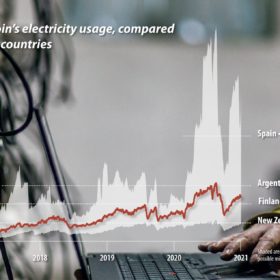
The weekend read: Crypto’s energy conundrum
In a financial world of stocks, bonds, foreign exchange, and credit cards, trillions of dollars are traded daily, with money flows handled by a bevy of databanks. In the world of cryptocurrency, billions of dollars worth of Bitcoin are traded through as many as 400,000 transactions per day, consuming the energy supply of a modernized country. The quirk is a “proof of work” feature that provides decentralized security. Is Bitcoin’s energy usage all for nothing, or is it a game-changer for renewable assets and generators? Tristan Rayner explores.

The Hydrogen Stream: Australia takes the spotlight with 1.7 GW project in Tasmania and new tech to produce hydrogen from rooftop PV
Elsewhere, Portugal’s EDP has unveiled plans to deploy 1.5 GW of green hydrogen capacity and, in Spain, several projects have been announced by Fotowatio Renewable Ventures (FRV), Iberdrola, Solaria Energía and Enagás.
Reuse or replace? IEA PVPS analysis considers all options for underperfoming PV modules
In a new report, experts from the International Energy Agency Photovoltaic Power System Programme (IEA-PVPS) have assessed the economical and environmental benefits of repairing and reusing or replacing solar modules that are not complying with a 30-year expected lifetime. They found that reusing offers the best environmental impact in all cases, while the profitability of this option is currently guaranteed only by rooftop PV under certain conditions. As for large-scale solar, module replacement remains the most competitive option.
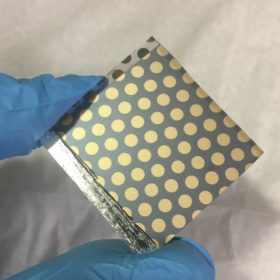
Rear-side passivation for 17.4% efficient CdTe thin film
Scientists in the United States investigated adding a layer of copper-aluminum oxide to the rear side of a cadmium-telluride thin film cell, finding positive impacts on carrier lifetime and efficiency. With further work, the scientists say, the discovery could open up new routes to higher efficiencies in CdTe solar cells.
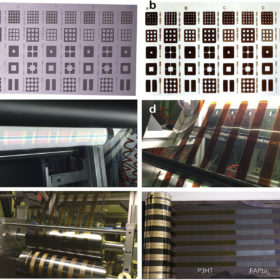
Flexible perovskite solar cells ‘from lab to fab’
Scientists in Korea evaluated recent progress in the development of low cost, large scale processes for the production of perovskite solar cells on flexible substrates, finding that several challenges remain. The group recommends that research should focus on developing novel processes and materials for perovskite solar cell production, rather than adapting those already in use elsewhere.
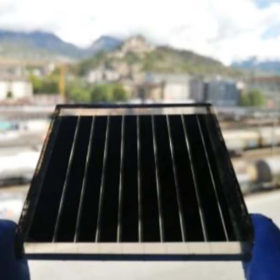
Isomer passivation for a 21.4% efficient perovskite module
An international team of scientists trialled a new approach to passivating defects in perovskite solar cells. Using a tailored arrangement of atoms, the team was able to overcome challenges related to the formation of a two-dimensional perovskite layer on top of the active cell material, and reach 21.4% conversion efficiency for a 26cm² active area, which they claim as a record for a perovskite device of this size.
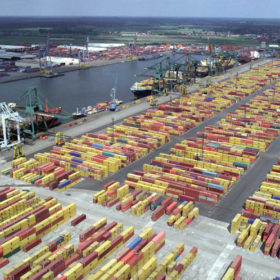
The Hydrogen Stream: Three more ports want to become hydrogen hubs
Antwerp, and Zeebrugge, in Belgium, and Newcastle in Australia all want to speed up green hydrogen development.
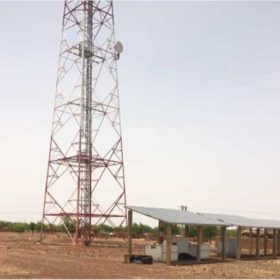
How PV performs close to radio, TV antennas
Researchers in Kenya have analyzed the performance of an off-grid PV system located near an isotropic antenna as an emitting source.
Solar Portfolio Management – The next innovation in project planning
Regularly working with spreadsheets for solar project and portfolio management can be challenging, inefficient, and hinder collaboration efforts and transparency. Until recently, most project development documents were kept in separate silos, updates were difficult to share, and important changes were sometimes missed altogether.
That picture is changing for the solar industry with the introduction of project management software. With ATLAS, a portfolio management software, FTC Solar is promising to offer the solar industry a “single point of truth” solution.

The Hydrogen Stream: ZF reactor tech for hydrogen production via steam methane reforming
Big plans for hydrogen development were announced this week in Germany, Namibia, Italy, Spain, Norway, Australia and the United States.
