
How albedo interacts with different rooftop PV system patterns
Researchers have simulated 160 cases of PV rooftop installation in southern and northern Italy. Among changing parameters were size and type of the panels, as well as their roof cover rate. The considered albedos were 20%, 40%, 60%, and 80%, representing different types of roof materials.

The impact of different substrates on solar module performance
A research team has analyzed the effects of different substrates on PV module performance and has found that ground soil achieves the highest efficiency at 21.1%, followed by grass (19.6%), wood (17.95%), concrete (16.2%), roof tiles (14.3%), and iron sheets (11.5%).

Optimal tilt angle for bifacial PV deployed on white-painted ground surfaces
Scientists in India have analyzed the performance of a bifacial PV module installed on a white-painted ground surface and have found a 30-degree tilt angle outperforms all other inclinations angles in terms of power output.
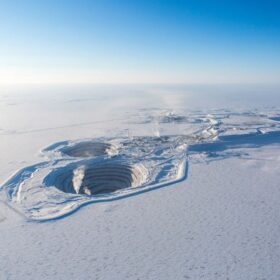
Rio Tinto building more solar at mining sites
Multinational mining company Rio Tinto has finished installation work at the Diavik Diamond Mine in Canada and has announced plans for two 5.25 MW plants at a bauxite mine in Australia’s Northern Territory.
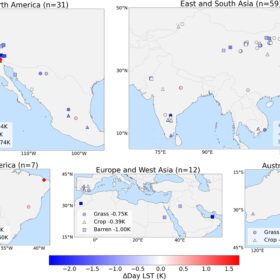
The effect of PV plants on albedo, vegetation, land temperature
Scientists have used remote sensing to analyze the effect solar farms have across 116 sites worldwide. They found that the cooling effect is higher during the daytime, with albedo decreasing by 0.016 for most facilities.
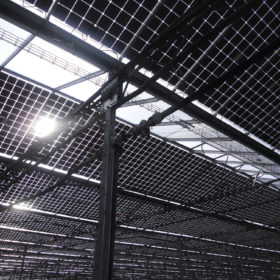
Satellite method estimates albedo for bifacial PV systems in ‘worst-case scenario’ areas
Scientists in the UK have utilized data from two different satellites – Sentinel-2 and MODIS – to develop a new and more accurate approach to estimated albedo for bifacial PV systems in complex landscapes. The novel methodology reportedly achieved a much lower normalized root mean square error than reference methods relying on MODIS only.
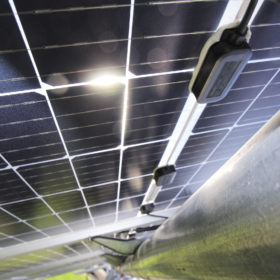
PVsyst-based comparative analysis for bifacial, monofacial PV projects
Scientists in Palestine say that controlled tests show that bifacial solar panels produce 6.81% more electricity than monofacial PV modules.
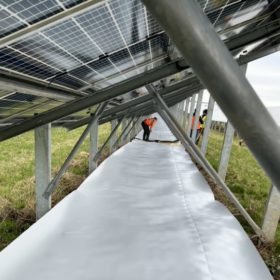
Reflective membrane to increase albedo, power yield in bifacial PV projects
Germany-based Solmax has developed a reflective membrane made of polyethylene resins and coated with a thin white polyethylene layer that reflects ultraviolet (UV) rays. The company claims the membrane can increase the energy yield of a bifacial PV project by between 5% and 20%, depending on the plant configuration.
Satellite-derived datasets to measure ground albedo for bifacial PV
A researcher from the NREL has set up a series of datasets of measured ground albedo values using measurement network data in the U.S. and data contributed by the PV industry. The measured albedo datasets are intended to help developers of ground-mounted PV projects in making a choice between monofacial and bifacial panels.
French bifacial standards measure up
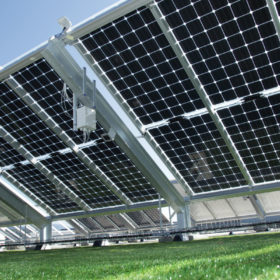
A global assessment of bifacial testing methods conducted in Singapore has endorsed the approach taken by France’s Institut National de l’Énergie Solaire.
