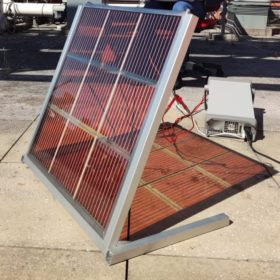
Semitransparent dye-sensitized solar module for BIPV applications
Scientists in Italy have developed a module with an area of 0.2 sm and an efficiency of 2.7% in outdoor conditions, with a tilt angle of 60 C. They designed it by considering the trade-off between low losses and device sturdiness.
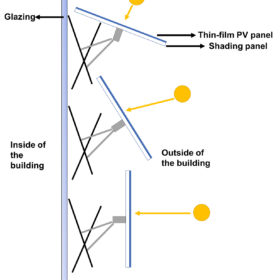
Designs, control strategies for PV-integrated shading devices
Photovoltaic shades in buildings offer energy efficiency and electricity generation, but an international research group says their commercial viability will depend on the control strategies used to optimize performance.
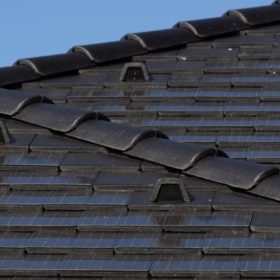
Hungarian start-up launches solar tile with output of 167W per m²
Developed by Hungarian manufacturer Terràn, the Generon solar tile is based on concrete support and weighs is in at 5.7kg.
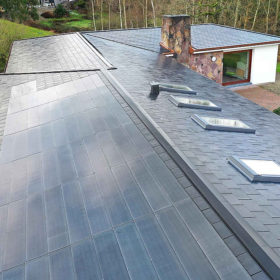
New solar tiles from Denmark
Danish BIPV specialist Dansk Solenergi has added two more tiles to its product range – an 18.15%-efficient dark grey panel and a 16.7%-efficient terracotta product. Both panels have an operating temperature coefficient of -0.34% per degree Celsius.
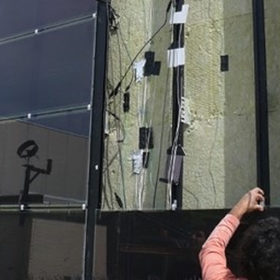
Photovoltaic forced ventilated facade for applications with air source heat pumps
Scientists in Spain have designed a BIPV forced ventilated facade that can be used as support for heating and a domestic hot water (DHW) building system based on air source heat pumps (ASHPs). In the proposed system configuration, the heat pump is expected to cover building heating demand at all times, regardless of the performance of the solar array.
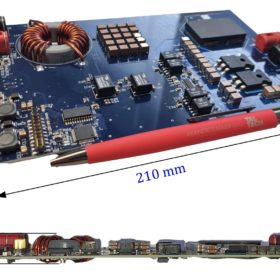
Novel power electronic converter for BIPV
Conceived by researchers in Estonia, the device is claimed to be compatible with both crystalline silicon and thin-film BIPV panels and to manage, easily, different voltage levels. It can be applied either in solar facades or BIPV rooftop arrays.
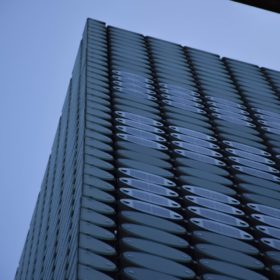
The best BIPV envelope design alternatives
Scientists in Australia have developed an optimization framework for building-integrated photovoltaics that allows the selection of design variables according to user preferences. Their model considers PV-related features such as tilt angle, window-to-wall ratio (WWR), PV placement, and PV product type, as well as objective functions and constraints such as the net present value and the payback period.
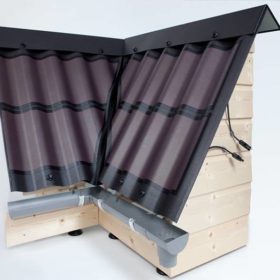
Solar foil for BIPV applications
HyET Solar and the Delft University of Technology are developing a photovoltaic foil technology that is claimed to be suitable for any type of surface. The solar foil has a 12.0% conversion efficiency and is based on hydrogenated amorphous silicon and nanocrystalline silicon in a tandem cell configuration.
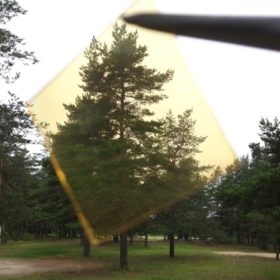
Semi-transparent antimony trisulfide PV cell for solar window applications
The 5.5%-efficient cell was fabricated through a low-temperature, two-step manufacturing process that is compatible with existing window glass manufacturing technology. Cells made with 70nm antimony trisulfide films achieved the best fill factor of around 57%, while the highest power conversion efficiencies were achieved with films ranging from 70 to 100nm.
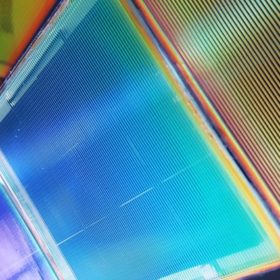
Colored optic filters for BIPV products
Dutch researchers have used optic colored filters to make building-integrated PV products more suitable for urban environments with cultural heritage value. They discovered that the filters do not affect a cell’s open-circuit voltage and fill factor, but only the short-circuit current.
