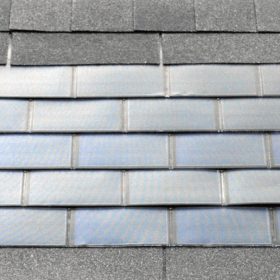
Defining BIPV
Incorporating solar into our built environments represents an opportunity for hundreds of gigawatts to be installed worldwide without taking up any additional land. In many cases though, this will require solutions beyond typical rooftop PV installations and much closer cooperation between the PV and construction industries. A new report published by IEA PVPS looks to bring together the interests of both worlds, and clearly categorize both the building envelope and energy functions of different BIPV components.
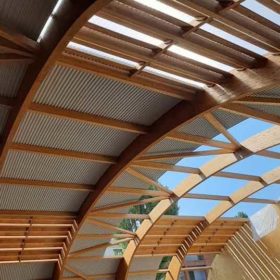
Deploying solar on curved metal roofs
Midsummer and Medacciai are developing a BIPV solution for curved metal roofs in southern European markets, through a five-year deal.

Color-tunable transparent silicon solar cell with 7.38% efficiency
Designed for BIPV applications by scientists in Korea, the solar cell is based on a 100μm-thick n-type silicon wafer and has a bending radius of 3-6mm.
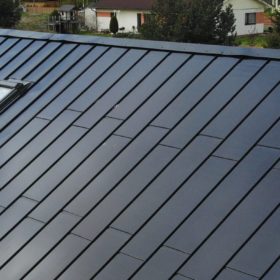
BIPV modules from Estonia
Estonian start-up Roofit.solar recently raised €6.4 million from a group of investors led by Germany’s Baywa r.e. The company will use the funds to commercialize its three BIPV modules with power outputs of 110 to 160 W. All products rely on a 0.5 mm metal back sheet with highly durable pural coating.

The solar facade with a golden glow
A 163 kW solar façade is powering the new building of Basel’s Office for Environment and Energy in Switzerland. Swiss manufacturer Megasol provided special modules on 3D fused glass for the vertical BIPV installation.
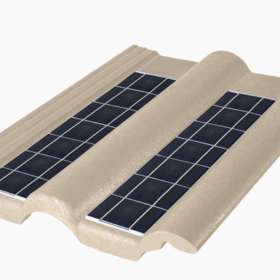
New solar tile from Brazil
Developed by Brazilian construction materials provider Eternit S.A., the tile has a nominal power of 9.1 W and an average monthly generation capacity of 1.15 kWh. It is available in five colors and two versions with a classic or reinforced design.

‘Solar skin’ planned for office tower in Australia
Australian real estate developer Cbus Property has revealed plans to clad a commercial office tower in Melbourne with a “solar skin” capable of generating 20% of the project’s base building electricity requirements.
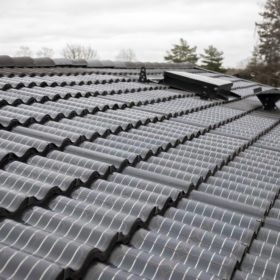
Rusnano tests made-in-Russia CIGS solar tiles
The 15%-efficient solar tile is manufactured by Russian producer Solartek with CIGS equipment provided by Sweden’s Midsummer.

Quantum dot solar window with 3.6% efficiency
U.S. manufacturer UbiQD has developed a solar window with laminated glass and luminescent solar concentrators, based on copper indium sulfide and zinc sulfide quantum dots. It is now testing pilot installations in Nevada.
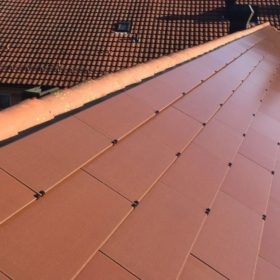
Solar tile with anti-glare coating from Switzerland
Swiss manufacturer Megasol said the new product is compatible with the most common tile formats and also available in different colors. Megasol has also developed a coating that eliminates the glare effect of solar modules.
