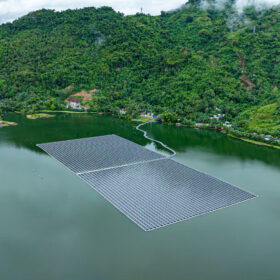
Philippines completes first MW-scale floating solar array
The Philippines has completed its first megawatt-scale floating solar array, a 4.99 MW installation on the Malubog reservoir, with plans to expand to 50 MW to power a copper mine. In Mindanao, work has begun on a 99 MW solar plant backed by PHP 4.49 billion ($80 million) in green financing from HSBC.
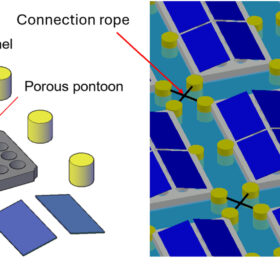
‘Soft-connected’ floating PV for offshore scenarios
An international research team has tested a floating PV system with a “soft-connected” configuration under offshore conditions, using six modular pontoons linked by elastic bar elements to simulate mooring lines and connection ropes.
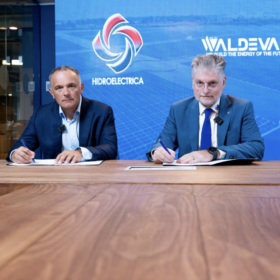
Romanian utility signs deal for 10 MW floating solar project on reservoir
Romania’s Hidroelectrica has signed a contract with Waldevar Energy for a 10 MW floating solar project billed as Europe’s largest on a reservoir.
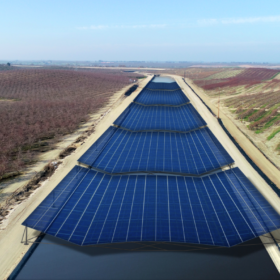
The best tilt angle for canal-mounted PV systems
Researchers in Türkiye have conducted an experimental study on the ideal tilt angles for PV systems deployed on canals. Their analysis showed that an 8◦ tilt angle consistently demonstrates greater performance.

Italy launches floating PV tender
The Italian authorities have opened a tender to support the deployment of about 50 MW of floating PV capacity.
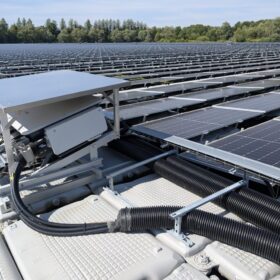
Q Energy switches on Europe’s largest floating PV plant
Q Energy and partners recently inaugurated a 74.3 MW floating PV plant in France – the largest of its kind in Europe. pv magazine visited the site to examine the technologies and innovations behind the project.
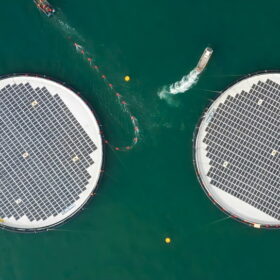
GCL SI presents 480 W solar modules for offshore projects
GCL System Integration (GCL SI) introduced its NT10/60GT floating solar module at the recent SNEC 2025 trade show in Shanghai. It developed the seawater-resistant solution in collaboration with Norway’s Ocean Sun.
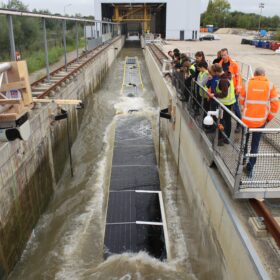
Offshore floating PV enduring world’s largest artificial waves
Offshore PV technologies were tested for the first time under the severe wave loads generated by Delta Flume, a 300 m long man-made flume with a wave generator that is capable of producing waves as tall as five meters. The testing is intended to standardize testing and certification processes for offshore floating PV systems.

High-frequency monitoring of floating PV
Researchers in Brazil have installed a vertical thermistor chain with six temperature loggers beneath a floating PV plant and at a nearby reference site. The system also recorded dissolved oxygen and photosynthetically active radiation to assess environmental impacts.
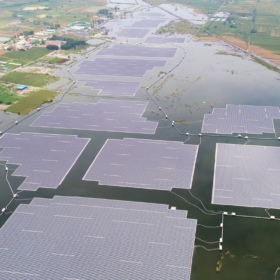
Water-based photovoltaics reach global capacity of 21.18 GW
An international research team has developed an index-based remote sensing method to see trends in the global development of water-based PV. It has found that China currently accounts for 80% of the global total deployed capacity.
