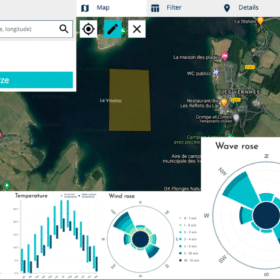
New tech to identify best locations for floating PV
Norway’s Glint Solar and the Norwegian Geotechnical Institute have developed an algorithm that is able to automatically calculate wave heights and wind directions at potential locations for floating PV arrays. It considers the geometry of the water surface as well as 40 years of data on wind conditions.
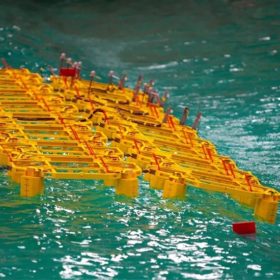
Floating structure design for offshore PV
Researchers at the Norwegian institute Sintef are testing a special floating structure that Equinor wants to deploy in offshore waters. The structure is built with an anchoring system that is claimed to give the installation enough freedom to cope with the waves.
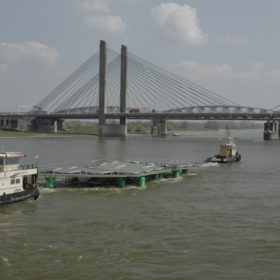
Offshore floating PV platform unveiled in the Netherlands
Dutch floating structure specialist Solarduck has built a pilot 65 kW floating PV array that will be connected to a 10 kW electrolyzer to produce hydrogen bonded with a liquid organic hydrogen carrier. The system is relying on the company’s proprietary floating technology that resembles an offshore oil platform.

Italy devotes €1.1bn to agrivoltaics, €2bn to energy communities and storage
The funds will be part of the EU Covid-19 recovery package. Overall, the Italian government expects to deploy 2 GW of agrivoltaics and 2 GW through energy communities.

No bifacial solar in West Africa? That’s likely to change soon
A technology-focused event held by the Africa Solar Industry Association has heard development pipelines across the continent are swiftly changing to accommodate double-sided PV panels, and that’s good news for solar tracker providers too.
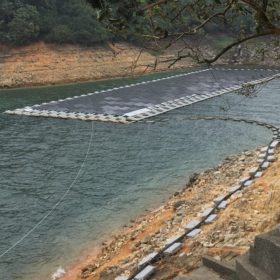
Australian utility to build floating PV plant, 200 MW battery
AGL Energy has revealed plans for a floating PV project at its Loy Yang power station in Victoria, Australia. The energy giant is already producing brown hydrogen for export to Japan, and has applied for a 200 MW battery at the Loy Yang site.

DNV publishes guidelines for proper deployment of floating PV
The Recommended Practice guide, on top of describing the most common requirements for building a floating PV array, provides a series of technical guidelines for electrical safety, anchoring and mooring issues, operation and maintenance, and specific plant design that can withstand site-specific environmental conditions.

Adriatic Sea to host 100 MW offshore PV plant
Italy’s Saipem is planning what could be the world’s largest offshore PV plant — a 100 MW facility located off the coast of the Italian northern region of Emilia-Romagna. The project, whose approval process began two years ago, is expected to become operational by the end of 2025.
How much floating PV is enough?
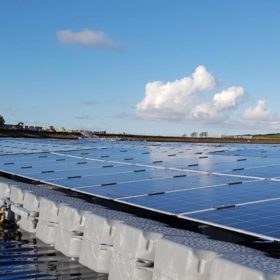
Scientists in the UK have had a closer look at the impacts of floating PV systems on the water. They found that their cooling effect on water mitigates blooms of toxic blue-green algae and increased water evaporation, which are both caused by global warming. They also warned, however, that colder water may result in a reduction of the duration of so-called thermal stratification. The right proportion between the surface occupied by the PV array and a water surface’s total area is key for addressing this issue.
India’s largest floating PV plant to go online by June
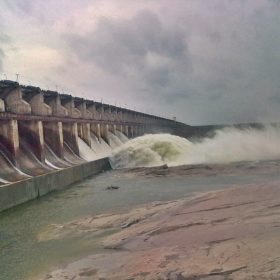
NTPC is now building a 100 MW floating solar array on a reservoir in the Indian state of Telangana.
