
EU policies could cut cost gap between European and Chinese solar modules
A report by SolarPower Europe and Fraunhofer ISE finds EU-made solar modules cost €0.103 ($0.12)/W more than Chinese imports, but targeted policies could close the gap and help reach the EU’s 30 GW annual manufacturing target by 2030.

Fraunhofer ISE defining test procedure for grid-forming inverters
The evaluation process, developed in collaboration with four German transmission system operators, has been carried out on seven European companies whose inverters range from kW to MW in size.
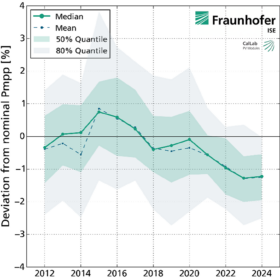
Fraunhofer ISE research finds solar module output ‘often overstated’
A longitudinal research project from the Fraunhofer Institute for Solar Energy Systems ISE reveals that since 2017, the institute has measured less power on average in a solar module than promised by the manufacturer.
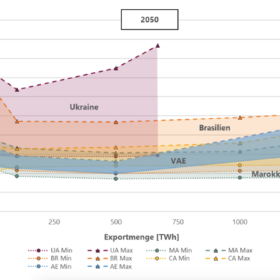
Global hydrogen atlas shows potential import countries for Germany
Researchers from the Fraunhofer Institute for Solar Energy Systems have analyzed the techno-economic potential of importing hydrogen to Germany from Brazil, Morocco, Canada, Ukraine and the United Arab Emirates.
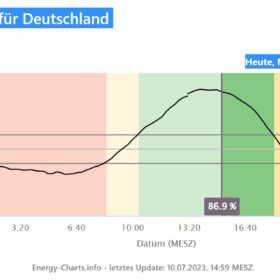
Fraunhofer ISE launches app to maximize consumption of renewables
Germany’s Fraunhofer Institute for Solar Energy Systems (ISE) has launched a smartphone app to help consumers use more electricity at times of high renewable energy availability.
Weekend Read: Waiting is not an option
In May 2022, PV experts from around the world convened in Germany for the third Terawatt Workshop. Almost one year later, takeaways from discussions at the workshop – combined with a wide-ranging review of research on decarbonization pathways, energy demand projections, and the state of the art in PV technology – led to the conclusion that 75 TW of installed solar capacity by 2050 was a realistic global target. More than 50 leading PV industry figures recently outlined the opportunity and the challenges that solar will face in reaching this goal.
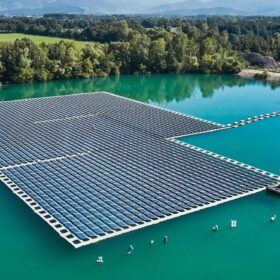
Impact of floating photovoltaics on thermal characteristics of lakes
A new study details how floating photovoltaics impact wind flow and irradiance on lakes, with the effect of influencing water temperature at different depths. However, the report’s authors say more research is needed on how to design systems for maximum benefit to the water bodies themselves.
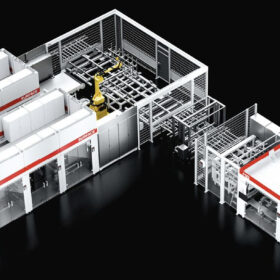
Euro solar is Surfacing
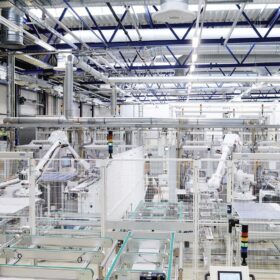
M10 Solar Equipment, a German joint venture, may have shown Europe’s solar manufacturers how to scale their gigafactories by using Siemens’ plant simulation software to ramp up production of its innovative shingled-matrix solar cell production equipment, explains Tobias Wachtmann, director of global glass and solar for Siemens.
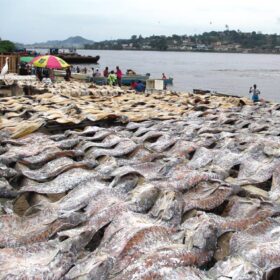
Producing the goods
Germany’s Fraunhofer Institute for Solar Energy Systems (ISE) is demonstrating how a solar-powered refrigeration unit and dryer could be self-sustaining and improve food security in Kenya.
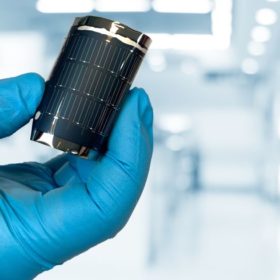
Swiss scientists achieve 22.2% efficiency for flexible CIGS solar cell
Scientists result have confirmed a 22.2% efficiency rating for a flexible CIGS solar cell with Germany’s Fraunhofer Institute for Solar Energy Systems.
