
AI control tech to improve coefficient of performance of air source heat pumps
Scientists from South Korea have developed a heat pump optimization technique that controls the secondary refrigerant flow. The proposed technology offers the advantage of bypassing the need to control the compressor of the heat pump, which is a function that is commonly not available in commercial devices.

PV-driven heat pump system for freshwater production, cooling, hot water
Scientists in India have combined a solar-assisted heat pump with a humidification-dehumidification and vapor compression refrigeration (HDH-VCR) cycle to generate heat and cooling. The system is reportedly able to generate up to 5.5 l per hour (LPH) of fresh water while achieving an ‘enhanced’ coefficient of performance.

Samsung unveils monobloc heat pump for residential applications
Samsung claims its new product is able provide domestic hot water of up to 75 C when the outdoor temperature is between -10 C and 35 C. It relies on an enlarged heat exchanger that the company claims is capable of transferring more heat compared to a conventional outdoor unit.
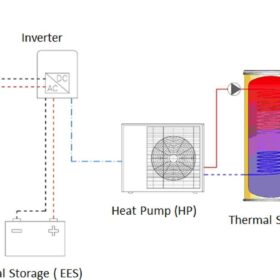
PV-powered heat pumps with thermal, electrical storage
Italian researchers have looked at the potential of thermal and electrical energy storage to improve self-consumption rates in buildings when coupled with PV-powered heat pumps. They have concluded that such an approach could yield self-consumption rates of more than 80%.
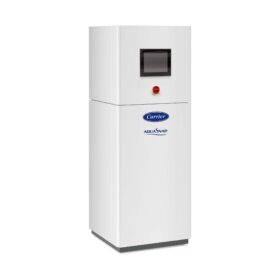
Carrier launches new series of high-temperature heat pumps
Carrier, a US-based heating solutions provider, has introduced a new line of high-temperature heat pumps with capacities ranging from 30 kW to 735 kW, with hydrofluoroolefins as a refrigerant.
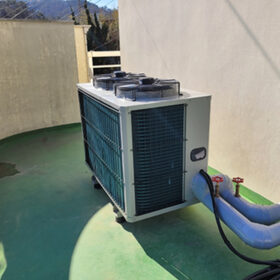
Integrated PVT–air source heat pump for deployment in limited space
South Korean scientists built an air source heat pump integrated with a photovoltaic thermal unit that can reportedly achieve an average heating and cooling coefficient of performance (COP) of 3.54 and 3.31, respectively. The system is also claimed to be 44% cheaper than ground source heat pumps combined with PVT energy.
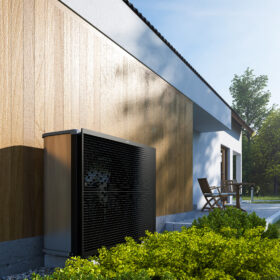
Daikin presents mid-temperature refrigerant split heat pump
The new product can reportedly provide a leaving water temperature of up to 65 C. It is available in three versions with outputs of 8 kW, 10 kW, and 12 kW, respectively.
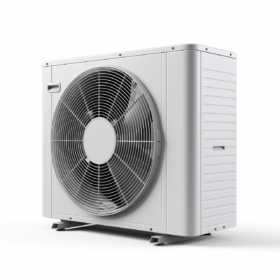
Leasing vs. buying a heat pump: Survey shows homeowners may prefer leasing
Swiss researchers conducted a survey among 1,582 single-family house owners located in Switzerland, Germany, and France to know more about their preference for leasing or buying a heat pump. They found that lease payments and lease contracts are crucial factors in decision-making, and that homeowners tend to prefer all-inclusive leasing products with lower monthly payments.
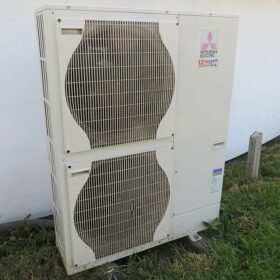
Challenges of integrating heat pumps into existing multifamily houses
New research from Germany shows that most of the heat pumps deployed in existing multifamily buildings may have to operate close to their water temperature operating limit (WTOL), thus being unable to provide elevated temperatures above 60 C. The researchers warned, however, that proper installation proceedings and new types of heat pumps may help solve this issue.
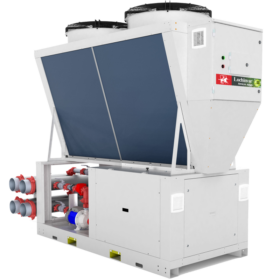
Lochinvar unveils heat pump to supply hot water at up to 70 C
Lochinvar has developed a heat pump with a hot water supply of up to 70 C, with a coefficient of performance (COP) of 5.5. The system is entirely cascadable, offering outputs ranging from 88 kW to 880 kW. It also includes 455 liters of hot water storage capacity and uses propane (R290) as a refrigerant.
