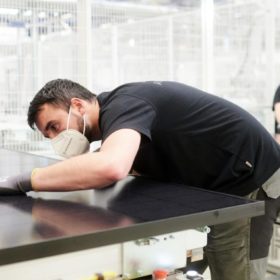
Meyer Burger wants to build another 400 MW factory
The Swiss manufacturer has secured €185 million for the expansion of its cell and module production. Meyer Burger no longer wants to sell its solar cells to third parties in the future.
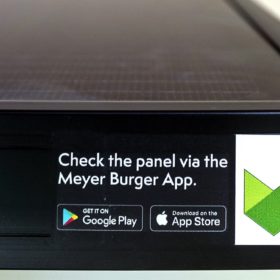
Smart sticker for smart solar modules
The sticker is based on a blockchain technology developed by German start-up Authentic Network. Meyer Burger uses the application for the photovoltaic modules it produces in its new factory that opened in Freiberg at the end of May.
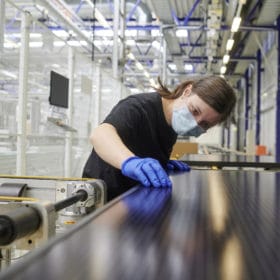
Meyer Burger begins manufacturing activities at 400 MW module factory in Germany
The Swiss manufacturer opened its module factory in Freiberg a few days after having begun manufacturing activities at its 400 MW cell factory in Thalheim.
Meyer Burger unveils 400 W heterojunction solar module
The solar module will be available in three versions – white, black, and glass-glass. The products have an output of up to 400 W, but when the bifacial effect is optimally used, the output of the glass-glass module can reach up to 430 W. Both the white and black modules weigh less than 20 kg
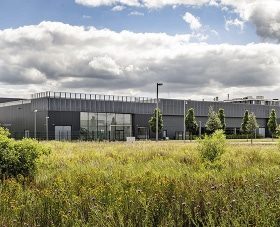
Meyer Burger buys wafers from different manufacturers
Before the official start of production, the Swiss photovoltaic manufacturer signed contracts with several suppliers that only use polysilicon produced by Wacker Chemie. Meyer Burger plans to start producing its solar modules and cells in Germany in the second quarter.
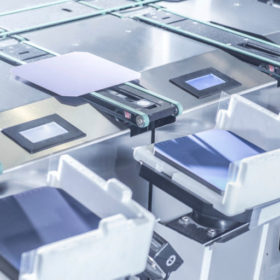
Meyer Burger wants to ship first HJT modules in July
The Swiss technology group wants to officially present its heterojunction modules, which are produced in Freiberg, Germany, at the end of April. Meyer Burger concluded its first official sales partnership in Switzerland, with Solarmarkt.
Meyer Burger to start PV cell, module production in May
Swiss solar manufacturer Meyer Burger is now looking for people to work at its new factories in Freiberg and Bitterfeld-Wolfen, Germany. The two facilities are scheduled to start production in May.
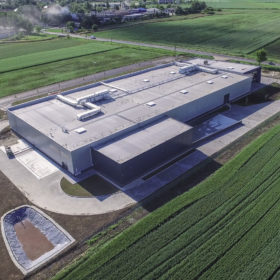
Meyer Burger and Ecosolifer sign settlement agreement on heterojunction cell line
The two companies have concluded a settlement after several years of stalling. Ecosolifer will pay for part of the cell production line ordered in 2015 but Meyer Burger will incur a net loss of almost CHF2 million.
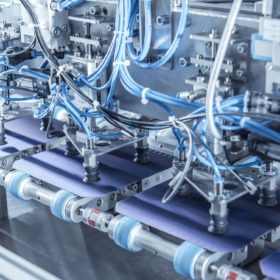
Meyer Burger and SMA call for an industrial strategy for PV production in Germany
The two PV companies have outlined how competitive value creation in Germany and Europe can succeed. This would also be important in order to preserve technologies and innovations in this country. Meyer Burger and SMA make four specific proposals in which they have an eye on both the generation of solar power and the manufacture of the photovoltaic products required for this.
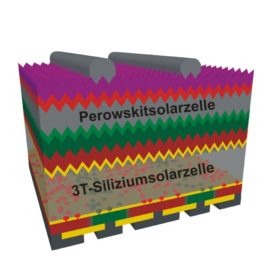
German-led consortium aims for 33% efficient perovskite-silicon solar cell
The Institute for Solar Energy Research Hamelin (ISFH), the Karlsruhe Institute of Technology (KIT) and the Institute for Materials and Components in Electronics at the University of Hannover, as well as Centrotherm, Singulus, Meyer Burger and Von Ardenne are involved in a research project aimed at achieving a 27% conversion efficiency for silicon solar cells based on perovskite.
