
US government renames National Renewable Energy Laboratory
The US Department of Energy (DoE) has renamed the National Renewable Energy Laboratory (NREL) in Colorado as the National Laboratory of the Rockies, a change it says aligns the institute’s mandate with the Trump administration’s applied energy priorities.
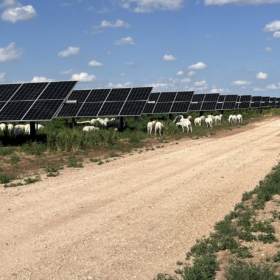
US study outlines gains and risks in agrivoltaic solar development
A new National Renewable Energy Laboratory (NREL) report says Massachusetts’ solar-on-farmland policy framework offers lessons for developers navigating both opportunity and regulatory complexity.
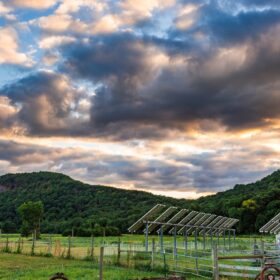
Agrivoltaic shading, full-sun fields gives farmers the power to pivot
Research conducted at the oldest agrivoltaic research site in the United States found year-to-year weather variability impacts agrivoltaic crop production, emphasizing the importance in conducting studies across multiple years.
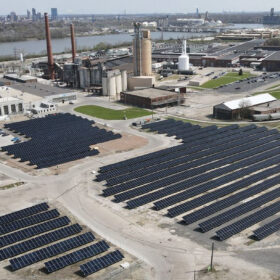
US, Canada ramp up solar glass plans
With PV module capacity ramping up, glass suppliers have been investing in new solar glass production capacity. As in India and China, new facilities are popping up in North America, with unique twists to ensure competitiveness, such as using recycled material.

NREL updates online tool with data for Africa, Eastern Europe, Middle East
The US Department of Energy’s National Renewable Energy Laboratory (NREL) has added a high-resolution solar data set covering Africa, Eastern Europe and the Middle East on its Renewable Energy Data Explorer tool.

Perovskite thin film: Out with the old, in with the new
Silicon-perovskite tandem solar requires optimization of both approaches, and embodies the weaknesses of each. Meanwhile, the use of pure thin-film devices offers a cheaper, simpler, and more sustainable PV solution for the United States.
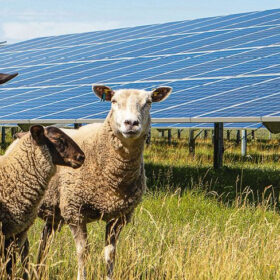
Has the US caught up with European agrivoltaic deployment?
With so much more agricultural real estate than Europe, the United States is building on the body of research built up across The Pond and rolling out solar panels on farmland at an impressive rate.
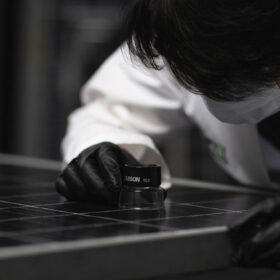
Weekend Read: Temper tantrum
Reports of broken module glass with no obvious cause have begun to crop up at large PV projects. Module design, glass manufacturing, and interactions in the field between modules and trackers are at play and a clear solution has yet to emerge. Early signs suggest an update to certification standards may be needed.
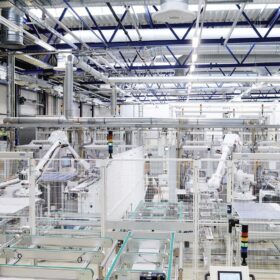
Weekend Read: Waiting is not an option
In May 2022, PV experts from around the world convened in Germany for the third Terawatt Workshop. Almost one year later, takeaways from discussions at the workshop – combined with a wide-ranging review of research on decarbonization pathways, energy demand projections, and the state of the art in PV technology – led to the conclusion that 75 TW of installed solar capacity by 2050 was a realistic global target. More than 50 leading PV industry figures recently outlined the opportunity and the challenges that solar will face in reaching this goal.
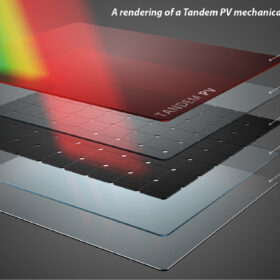
Weekend Read: Pushing perovskite PV limits
The perovskite solar race is heating up, with a cue of manufacturers forming to test products at the US Department of Energy’s (DoE) PV commercialization facilities, and academics on both sides of The Pond announcing new advances in recent months.
