
Investigating backsheets and ultraviolet stability
Five testing laboratories led by Germany’s Fraunhofer ISE have begun a ‘round robin’ project to test the effects of ultraviolet light on polymer backsheet materials. Initial results indicate a route to accurate accelerated testing of backsheet UV stability over module lifetimes of 20 years-plus.
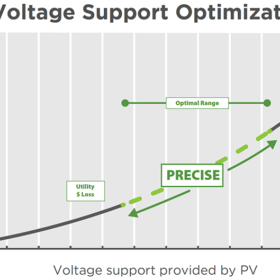
Preconfiguring and controlling inverter set-points
Researchers from the U.S. National Renewable Energy Laboratory have developed a tool to balance customer curtailment and grid stability. The “Precise” tool for utilities provides unique inverter settings tailored to each customer, with minimal investment and labor for companies that use it.
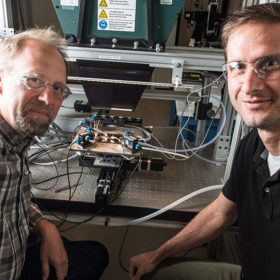
Six-junction III–V solar cell with 47.1% efficiency
A U.S. research group has developed a new solar cell, based on six active photoactive layers, to capture light from a specific part of the solar spectrum. The scientists claim that they could potentially reach a 50% efficiency rate with the new cell.
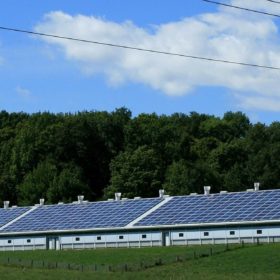
A big grid solution to harness small solar arrays
Scientists at the U.S. National Renewable Energy Laboratory are developing a communication system to coordinate and control the volumes of solar power injected into grids by small scale solar arrays.

Focus on the negatives: A new path to highly efficient tandem cells
Scientists in the U.S. and South Korea have identified what could be a new route to high-efficiency perovskite-silicon tandem solar cells. Through engineering negatively charged particles in the passivation layer, the group made a tandem cell with 26.7% efficiency. With further tweaks to the silicon layer they expect to be able to surpass 30%.
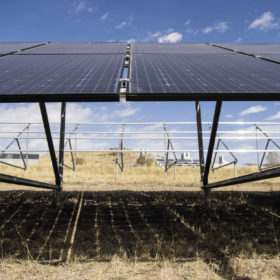
Building on bifacial momentum
Getting the most out of a bifacial module requires a rethink at almost every level of system design and the industry is hungry for field data generated by such systems to better inform energy yield modeling and define the best approaches to maximizing yield at minimal cost. In May, the U.S. National Renewable Energy Laboratory began a three-year study into bifacial performance which is beginning to yield results.
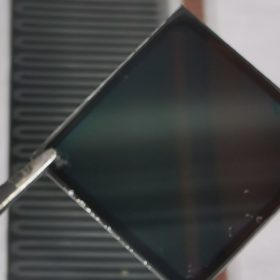
International consortium claims 25% efficiency for perovskite CIGS solar cell
Researchers led by Belgian institute imec claim to have achieved the result with a 1cm² perovskite tandem solar cell. The result tops the 24.6% efficiency the consortium announced in September 2018. The cell’s developers are now aiming for 30%.
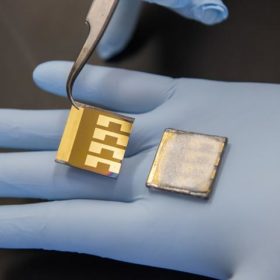
Preventing lead leakage in perovskite cells
A U.S. research group has used a lead-absorbing material to coat the front and rear of a perovskite solar cell stack. The researchers claim the films captured 96% of lead leakage when the cells were damaged.

A quantum dot solar cell with 16.6% efficiency
Scientists at Australia’s University of Queensland have set a new world efficiency record for a quantum dot solar cell. The group fabricated a 0.1cm² device from a perovskite material and measured power conversion efficiency at 16.6%. The record has been verified by the United States National Renewable Energy Laboratory.

Innovative PV modules at Intersolar San Diego
In sunny San Diego for Intersolar 2020, we’re seeing a new idea for tracking rooftop solar modules, diodes moving to cell level, two types of building-integrated solar products and some solar hot water.
