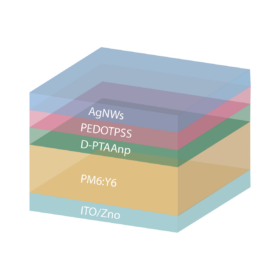
Organic solar cell based on PEDOT:PSS hole transport layer achieves 17.1% efficiency
A team of researchers in Germany has fabricated a non-fullerene acceptor-based organic photovoltaic cell featuring a bilayer solution-processed hole transporting layer. It recorded a power conversion efficiency of 17.1% and maintained 93% of its initial efficiency after 1,800 hours under continuous solar cell operation at 60 C.
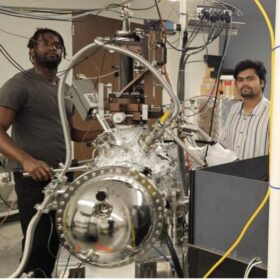
Organic solar cell gains counterintuitive efficiency boost from entropy
A research team at the University of Kansas have found that organic semiconductors known as non-fullerene acceptors demonstrate a high solar cell efficiency due to a reversed heat flow.
Using digital twin, roll-to-roll platform to design high-performance organic PV devices
An international team of researchers have demonstrated how to speed up the research and development of scalable, high-performing organic solar cells by using an automated, high-throughput platform. It relies on digital twin technology and roll-to-roll (R2R) printing in a closed-loop system.

Semitransparent organic cell achieves bifaciality factor of 99.1%
A team of researchers from two Chinese universities achieved a bifaciality factor of 99.1% with a semitransparent organic cell, the highest reported bifacial factor in such cells to date. The cell also achieved a power conversion efficiency of 12.5% and an average visible light transmittance of 22.9%.
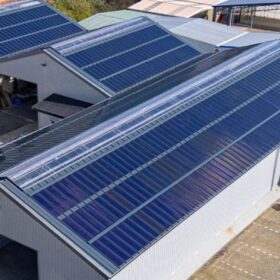
Heliatek develops lightweight organic PV module for low load-bearing roofs, facades
German organic PV manufacturer Heliatek has announced a new series of lightweight modules. The Heliasol 436-2000-CFE-45-600V panels are IEC 61215 and IEC 61730 certified and have a 20-year lifetime warranty.
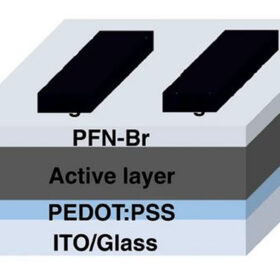
Organic solar cell based on trichlorobenzene achieves 19.31% efficiency
An international research team developed an organic solar cell based on a novel non-monotonic intermediated state manipulation strategy. The device reportedly showed non-radiative recombination losses while exhibiting remarkable power conversion efficiency.
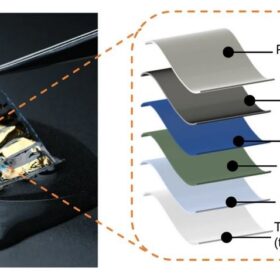
Japanese researchers build 14.3%-efficient bendable, waterproof organic solar cell
Researchers from Japan’s Riken Center for Emergent Matter Science have fabricated an organic solar cell that has achieved waterproofness without reducing flexibility. At 3 micrometers thick, it is thought to be the first cell of its kind to survive a washing machine cycle and retain efficiency after multiple cycles.
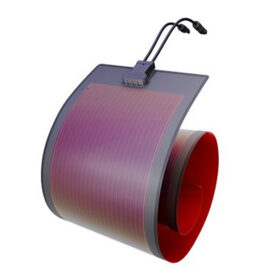
TÜV Rheinland certifies organic PV product based on IEC 61215 standard
German certification body TÜV Rheinland has announced the certification of the first organic photovoltaic (OPV) product – an organic PV foil from Germany’s Heliatek – based on the IEC 61215 standard.
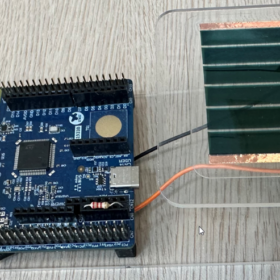
Dracula Technologies, STMicroelectronics unveil photovoltaic illuminometer
France’s indoor organic PV specialist Dracula Technologies and Swiss-headquartered semiconductor manufacturer STMicroelectronics demonstrated a battery-free illuminometer at the Embedded World trade fair in Germany last week.
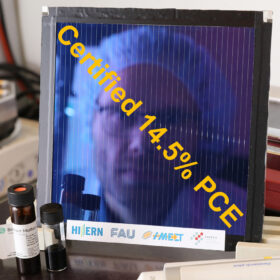
Large area organic PV module achieves world record efficiency of 14.5%
The module has a size of 143 mm x 143 mm and an active area of 204.11 cm². The result was certified by the Fraunhofer Institute for Solar Energy Systems (Fraunhofer ISE).
