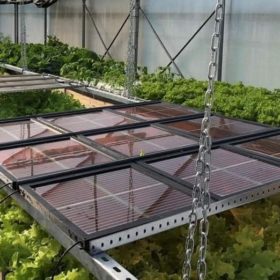
Semi-transparent solar module for greenhouse applications
Manufactured by scientists in Italy, the 3.88%-efficient organic solar panels are able to filter the light from the roofs of greenhouses. They are also capable of supplying a portion of the electricity required to power the greenhouse’s temperature and humidity sensors.
New discovery could make organic PV competitive with crystalline silicon
A group of international researchers has observed how non-radiative charge recombination occurs in organic PV and claims to have identified a potential solution that could bring this solar tech closer to crystalline silicon in terms of power conversion efficiency.

Flexible organic PV films on clothing offer charging on the move
The sustainability claims of a crowdfunded ‘e-textile’ range launched by Art by Physicist are borne out by the fact each garment will be printed on demand.
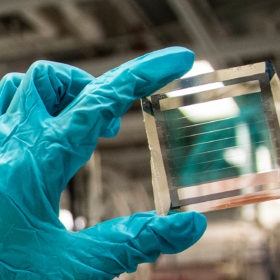
Semi-transparent organic solar cell for window applications
Developed by U.S. scientists, the 10%-efficient device is intended for applications in solar windows and promises efficiencies close to 15%. According to its creators, the cell retained 80% of its efficiency after 1,900 hours at 55 degrees Celsius.
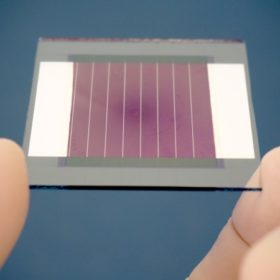
Mini organic solar module with 13.94% efficiency
The panel is based on 14.9%-efficient organic PV cells with a surface of 1.1 cm2 that the same research group unveiled in September 2020. The solar cells were interconnected using laser structuring.

Organic solar panels designed with coloured Moiré effect
French organic PV specialist Armor, and a Dutch designer specialized in integrating PV in furniture, windows and other objects, have provided the module technology for the Netherlands’ pavilion at Expo 2020 Dubai.

Nanocomposite films for 13.57%-efficient organic solar cell
Scientists in Malaysia have used, for the first time, nanocomposite films based on zinc oxide and polyvinyl alcohol in organic solar cells. These films were able to improve the efficiencies of the PV devices by up to 3.5%.
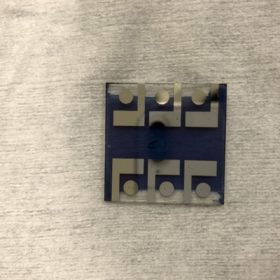
Organic solar cell with 18.4% efficiency via new electrode coating
Saudi scientists built the cell’s electrode with a hole-transporting molecule called Br-2PACz and not with the commonly used PEDOT:PSS. It helped improve the photovoltaic cell efficiency by around 0.9%.
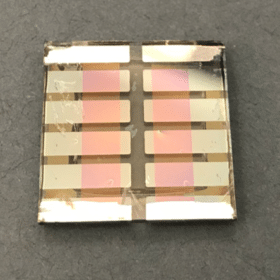
Organic solar for optical wireless data receivers
Researchers in the United Kingdom have built a 14%-efficient organic PV device that can be used in high-speed optical wireless communication systems. The cell consists of a 4×2.5mm photoactive layer fabricated with a bulk heterojunction of a polymer donor and fullerene and non-fullerene acceptors.
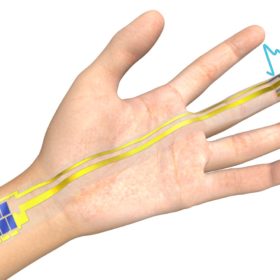
I’ve got solar over my skin
Researchers in Japan have built a PV-powered device to measure volumetric variations in blood circulation. The system, which is just a few microns thick, was built with an organic solar module, a polymer light-emitting diode (PLED), and an organic photodetector.
