Organic solar cell with 18.4% efficiency via new electrode coating


Researchers from the King Abdullah University of Science and Technology (KAUST), in Saudi Arabia, have fabricated an organic solar cell with an ultra-thin electrode coating that is claimed to raise the efficiency of this kind of PV device by 0.9%.
The scientists decided to build the electrode with a hole-transporting molecule called Br-2PACz and not with commonly-used thin films based on PEDOT:PSS, which is a conjugating-based polythiophene polymer. This compound was bound to an indium tin oxide (ITO) electrode to form a single-molecule layer.
The new coating was tested on an organic cell developed by the KAUST scientists and its efficiency rose from 17.5% to 18.4%. “Br-2PACz increased the cell’s efficiency in several ways,” the research group explained. “Compared with its rival, it caused less electrical resistance; improved hole transport; and allowed more light to shine through to the absorbing layer.”
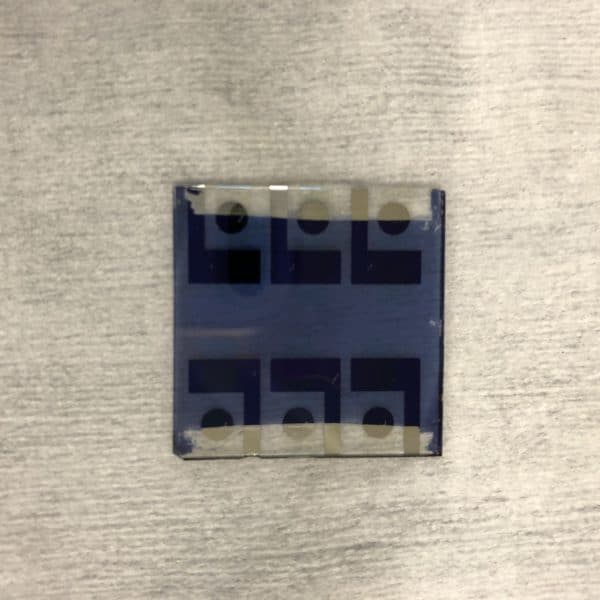
Image: King Abdullah University of Science & Technology (KAUST)
Moreover, the Br-2PACz also improved the structure of the light-absorbing layer itself, which the scientists attributed to the coating process. The latter is claimed, in fact, to enable the recyclability of the solar cell, as the ITO electrode can be removed from the cell’s coating and be used for other applications.
The discovery of the new material for the electrode coating, according to the Saudi team, may revolutionize the research in organic solar. “We believe Br-2PACz has the potential to replace PEDOT:PSS due to its low cost and high performance,” said KAUST researcher Yuanbao Lin.
This content is protected by copyright and may not be reused. If you want to cooperate with us and would like to reuse some of our content, please contact: [email protected].

Please login to comment

[…] which each measured 20cm by 10cm, and which were arranged in a single layer on a substrate made of PEDOT:PSS coated onto a polyethylene terephthalate (PET) […]
[…] which each measured 20cm by 10cm, and which were arranged in a single layer on a substrate made of PEDOT:PSS coated onto a polyethylene terephthalate (PET) substrate.The filters were placed on top of boxes […]