
Building-integrated concentrating photovoltaics for vertical applications
An Indian-British research team has developed a building-integrated linear concentrating PV facade by sandwiching an asymmetric compound parabolic concentrator, PERC cells, and encapsulation layers between two sheets of glass. The system was tested under both indoor and outdoor conditions and its payback period was found to be of up to 11 years.
EU updates Photovoltaic Geographical Information System
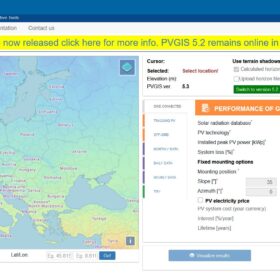
The EU Joint Research Centre (JRC) has updated the core technologoy of the Photovoltaic Geographical Information System with the aim of reflecting the dominance of crystalline silicon solar technologies over thin-film counterparts in the global energy market.
Three-year field test shows TOPCon, HJT solar module reliability in desert areas
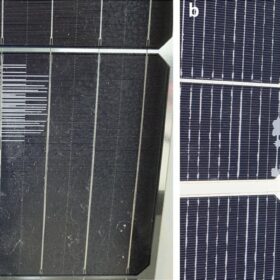
A three-year field experiment comparing the performance and reliability of passivated emitter and rear cell (PERC), tunnel oxide passivated contact (TOPCon), and silicon heterojunction (SHJ) modules in desert climates found that HJT modules exhibited the highest degradation, while TOPCon modules showed the lowest degradation.

Testing shows BIPV using patterned glass performs better than expected
Scientists have compared conventional PV modules to self-made BIPV panels with thicker, patterned glass. They tested them both under standard conditions and outdoors under Korean summer conditions. Yield was found to be only 0.5% lower in the textured BIPV module.
Scientists estimate material demand for all silicon PV module technologies by 2050
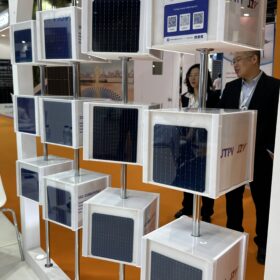
Dutch researchers used dynamic modelling to uncover the demand for silicon-based PV materials used in a wide range silicon PV technologies, including perovskite-silicon tandem and back-contact modules. The model included calculating the impact of advances in module efficiency and material intensity, as well as circular closed loop recycling.
US solar prices double European costs amid regulatory challenges
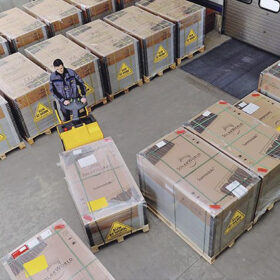
The requirements of measures such as the Uyghur Forced Labor Prevention Act (UFLPA) mean that solar panel prices in the United States can be twice as much as in Europe.
PERC solar products hard to sell due to falling TOPCon module prices
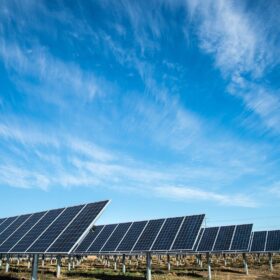
Prices for tunnel oxide passivated contact (TOPCon) solar panels continue to fall. pvXchange.com founder Martin Schachinger explains how this will affect the sale of PV modules based on passivated emitter and rear cell (PERC) cells.
China’s solar dominance set to continue amid price slide
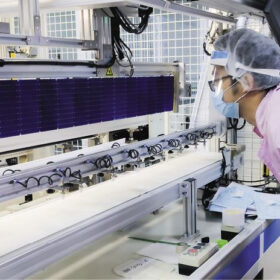
With solar module oversupply triggering a price freefall in 2023 and no recovery in sight, market consolidation, inventory pile-up, technology shifts, and challenges to reshoring PV manufacturing are set to affect all levels of the solar supply chain.
Astronergy presents TOPCon busbarless solar modules with 23% efficiency
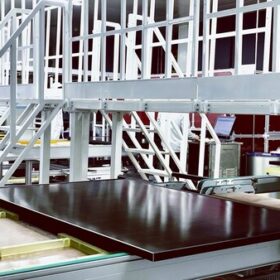
The Chinese module manufacturer announced the first shipments of its new ASTRO N7s ZBB-TF modules to Europe. The product has a power output of up to 460 W and a temperature coefficient of -0.29% per C.

Weekend Read: Famine to feast – China’s solar market in 2023
China’s solar industry rebounded in 2023 after years of pandemic-related sluggishness. As the year draws to a close, pv magazine looks back at key highlights of 2023 and considers the prospects for 2024.
