
Modeling subcell degradation rates in perovskite-silicon tandem solar modules
Researchers in the Netherlands developed a model to identify tolerable degradation rates of the top cell in perovskite-silicon tandem modules. Simulations showed that an increase in tandem module efficiency from 28.0% to 32.9% could raise the tolerable degradation rate by approximately 50%.

JinkoSolar pushes on perovskite-silicon tandem solar with new partnership
JinkoSolar has signed a strategic cooperation agreement with XtalPi, an “AI for Science” platform company, to pursue high-throughput R&D on perovskite-crystalline-silicon tandem solar cells using an AI platform and quantum-physics-based models.

Eni, FuturaSun set up startup for perovskite-silicon tandem module production
Italian energy group Eni and solar manufacturer FuturaSun have launched SunXT, a new startup focused on developing and producing perovskite-silicon tandem solar modules, building on FuturaSun’s research expertise.
The impact of transparent conductive electrodes on perovskite-silicon tandem solar cell performance
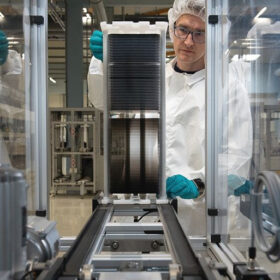
An Oxford researcher has found that transparent conducting electrodes can reduce perovskite–silicon tandem solar cell efficiency by over 2%, with losses linked to electrical resistance, optical effects, and geometric trade-offs. Using a unified optical–electrical model, the scientist showed how careful optimization of TCE stacks, coatings, and cell design is critical to closing the gap toward the 37%–38% efficiency frontier.

Perovskite-silicon tandem solar cell with steric complementary design achieves 32.3% efficiency
Researchers in China developed a monolithic perovskite-silicon tandem solar cell using a steric-complementary interface design, achieving a certified efficiency of 32.12% and enhanced long-term stability. This strategy optimizes molecular fit in the perovskite lattice, improving both charge transport and device longevity.

Chinese researchers build 31.71%-efficient perovskite-silicon tandem solar cell based on new interfacial engineering
The two-terminal perovskite–silicon tandem solar cell was fabricated through a chemical polishing method that selectively removes residual lead(II)iodide from the perorvskite film in the top cell. This targeted interfacial engineering improved uniformity and stability, enabling a certified 31.71% efficiency and enhanced long-term performance.

Fraunhofer ISE achieves 30.6% efficiency for perovskite-silicon tandem based on industry-standard bottom TOPCon cell
Researchers at Fraunhofer ISE have developed a perovskite-silicon tandem solar cell using a TOPCon bottom cell with standard textured front surfaces. Their results show that TOPCon bottom cells can perform comparably to heterojunction cells in tandem devices in terms of shunt resistivity, supporting scalable, cost-effective industrial production.

Longi achieves 33.35% efficiency for flexible perovskite-silicon tandem solar cell
The Chinese manufacturer said the tandem device was developed through a dual-buffer layer strategy that improves interfacial adhesion while preserving efficient charge extraction. The efficiency result was certified by the US Department of Energy’s National Renewable Energy Laboratory (NREL)
The impact of sunlight spectral shifts on bifacial perovskite-silicon tandem solar cells
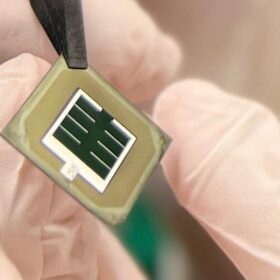
Experts from the International Solar Energy Society explains how regional spectral shifts of the standard spectral distribution of sunlight bring new insights into the performance of bifacial perovskite-silicon tandem solar cells.

KAUST, Franuhofer ISE announce 33.1%-efficient fully texturized perovskite-silicon tandem solar cell
The fully textured tandem cell achieved an open-circuit voltage of 2.01 V and an “extended” outdoor stability in the Red Sea coast, according to the researchers.
