
TNO offers mass customization line for integrated PV applications
The Dutch research institute’s highly automated research line offers customized, flexible solar semi-finished PV products to partners developing integrated PV applications.

Building the perfect perovskite, one layer at a time
A University of Cambridge-led team of researchers have demonstrated precisely controlled layer-by-layer epitaxial vapor growth of two-dimensional halide perovskite films in an industrially compatible process. Their findings could help develop more thermally stable perovskite solar cells.
All-perovskite tandem solar cell with dipolar passivation achieves 30.1% efficiency
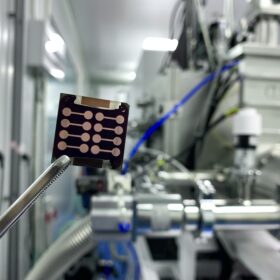
Researchers in China have developed a dipolar passivation method that reduces defects and improves charge transport in solar cells based on narrow-bandgap tin lead perovskite. The approach has enabled the fabrication of all-perovskite tandem solar cells with efficiencies of around 30% and enhanced stability,

JA Solar builds inverted perovskite solar cell with 26.7% efficiency
The Chinese manufacturer said the cell uses a multifunctional organic ammonium salt to improve interfacial engineering between the perovskite absorber and the electron transport layers. The device also achieved 24.5% efficiency when scaled up to a 1 cm² active area.

Inverted perovskite solar cell based on self-assembled monolayer achieves 26.92% efficiency
Researchers in China have developed an inverted perovskite solar cell approaching the 27% efficiency threshold. The device incorporates a specially designed self-assembled monolayer that passivates perovskite defects and enhances efficiency.
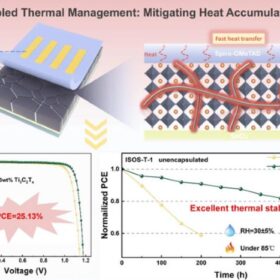
Perovksite solar cell based on MXene achieves 25.13% efficiency
A Chinese research group claims to have achieved remarkable efficiency and stability in a solar cell based on a perovskite absorber incorporating MXene, a novel type of 2D material known for its excellent conductivity, chemical stability, and thermal resilience. The device reportedly retained 80% of its initial efficiency after 500 hours.

Standardized testing for indoor PV
Researchers at Simon Fraser University in Canada have proposed protocols for standardized testing to avoid skewed results. The validated recommendations cover procedures for key measurements and the use of the indoor PV reference cell method.

Perovskite quantum dot solar cell achieves record-breaking efficiency of 18.3%
Conceived by scientists in China, the cell was built with an alkaline treatment that modulates efficiently the perovskite quantum dots surface chemistry. The device reportedly achieved the highest power conversion efficiency ever reported for this kind of solar cells.
Scaling perovskite tandems’ U.S. prospects
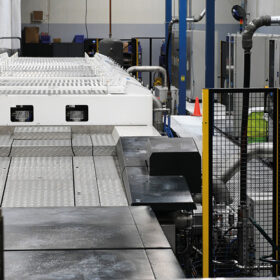
Three US manufacturers actively working to commercialize their respective perovskite-silicon tandem technologies make the case for tandem modules. CubicPV, Caelux and Swift Solar argue a commercial future for perovskites is inevitable, and they tell pv magazine the current policy environment could work in the technology’s favor.

Solaires Entreprises ships indoor perovskite PV modules to first customer
Solaires Entreprises, a Canadian perovskite startup, has begun supplying indoor PV modules for integration into sensor devices, marking its first commercial shipment.
